Monday, December 16, 2013

St. Dorothy Kazel: A Life of Service Led To Her Martyrdom

Sister Dorothy Kazel, modern-day martyr

Dorothy L. Kazel, baptized Dorthea Lu Kazel, was born to Lithuanian American parents, Joseph and Malvina Kazel, in Cleveland, Ohio, on June 30, 1939. Shortly after entering the Ursuline Sisters of Cleveland in 1960, she was given the religious name of Sister Laurentine, in remembrance of an Ursuline nun martyred in the French Revolution.

One of Dorothy's life themes was reaching out to those marginalized within our schools, our city and our nation; and ministering to those at risk of violence and war in El Salvador.

Dorothy joins mission team in El Salvador

As a member of the Cleveland Latin American mission team from 1974 to 1980, Dorothy came to know and love the Salvadoran people. Especially in the parishes of Chirilagua, La Union and La Libertad, and in outlying villages and cantons, including Zaragoza. She loved the exquisite, mountainous country with its faith-filled people who lived in extreme poverty.

She traveled by motorbike and jeep preparing for liturgical celebrations, serving as a vital communication link between the parishioners and the parish, and striving to develop lay leaders within the Church, with the hope they, in turn, would teach others in their village.

While serving in the CARITAS program, Dorothy taught women how to properly care for and nourish their children. "There was a constant working with the people, empowering them, trying to get them to do the teaching and the coordinating," says Sister Martha Owen, who served with Dorothy. She and other Sisters and laywomen on the team taught native men and women to read and write.

In 1977, a civil war emerged. Professional death squads murdered professionals, campesinos, catechists, and priests, and often destroyed villages and crops. Dorothy worked with victims and refugees of the war, widows and mothers who had lost their sons. "I could not leave Salvador, especially now ... I am committed to the persecuted Church here," she said.
Dorothy among four women missionaries killed

On the night of December 2, 1980, Sister Dorothy Kazel, lay missioner Jean Donovan and Maryknoll Sisters Maura Clarke and Ita Ford were abducted from the La Libertad airport, interrogated, physically and sexually abused and shot by five national guardsmen. The next morning they were found buried in a common, shallow grave, marked with a cross of two branches.

On December 4, the women's bodies were drawn from the burial site into Cleveland's, the nation's, and international consciousness. Dorothy's body was returned to Cleveland, Ohio, where Bishop Anthony M. Pilla celebrated the Mass of Christian burial at the Cathedral of St. John the Evangelist December 10, 1980.

The casket was flanked by an honor guard of priests, as bishops led the procession out of the Cathedral. One thousand, five hundred people attended the funeral. Her grave site in All Soul's Cemetery in Chardon, Ohio, is a place of pilgrimage. Sister Dorothy is celebrated annually at liturgies, at interfaith gatherings and in academic settings.

Her so-called ordinary life as a woman with the title of Sister was revealed to have been extraordinary. Her death has been a catalyst for many groups of diverse people to unite and advocate for social justice at local, national and international levels.

A critical awareness of the United States' role in Central America, its failure to protect human rights, and its participation in the training of the military arm of oppressive regimes became evident as the circumstances surrounding Dorothy's death became public. Her murder, torture and rape mirrored the fate of more than 40,000 Salvadorans, and thousands of Hondurans, and Guatemalan people.
Dorothy's death brings outcry and action

The Ursuline Sisters of Cleveland and all religious communities of women were inspired to action on behalf of women as victims of violence, and to see the connection between rape and war. After the murder of another Ursuline in 1995, the Ursulines of Cleveland initiated Women Watch, an annual event in April to commemorate women and children who were victims of violence in Cuyahoga County within the past year.

Dorothy's life continues to provide valuable information about women who enter religious communities of Sisters, about their motives, their struggles and their spirituality.

Her story provides insight into the complex human dynamic of choices women religious have made, and their efforts to enflesh the message of Jesus Christ through lives of contemplation,justice, and compassion at the end of this 20th Century. The four churchwomen's biographies document lives lived with Gospel's values in El Salvador, as well as the faith, culture, and experience of Salvadoran people. A movie, Roses in December (mid-1980s), focused on the lives of Dorothy and Jean Donovan. Dorothy's biography, "In the Fullness of Life," written by Sister Cynthia Glavac, was published in 1996.

In March of 1993, the United Nations Truth Commission Report for El Salvador, From Madness to Hope: the 12-Year War in El Salvador, concluded evidence was sufficient to support that "the arrest and the execution of the four women had been planned and carried out based on orders from a higher superior."

The Inter-Religious Task Force on Central America in Cleveland and Washington, D.C., has been actively engaged with many other groups to stop federal funding of the Western Hemisphere Institute for Security Cooperation (WHINSEC), formerly known as the School of the Americas (SOA). Efforts to stop training in torture and de-stabilization of Latin American governments follows evidence that three of five officers cited in the rapes and murders of Dorothy, Jean, Ita, and Maura; that two of the three officers cited for the assassination of Bishop Oscar Romero; that 19 of the 26 officers cited for killing the six Jesuits, their housekeeper, and her daughters were graduates of SOA.

Amnesty International condemned SOA training manuals containing interrogation techniques of torture, execution, blackmail, and arresting the relatives of those being questioned. Nationally, thousands of people have mobilized to close the SOA, challenging the concept of foreign aid as military training in terror and violence. Because of these efforts, one can say that Dorothy's death had national significance with international implications.  

Ursuline Sisters continue to serve the people of El Salvador through the Cleveland Diocese's mission team.

Sunday, December 15, 2013

Comment Moderation is In Effect

Sorry to have to do it again, but comment moderation will be in effect for the time being.

to minister to the poor and oppressed, the imprisoned, St. Maura Clarke

From the Maryknoll archives:

Born: January 13, 1931 
Entered: September 6, 1950 
Died: December 2, 1980

Dear Sisters, Family, and Friends:

At our prayer service as the Panama/Nicaragua/El Salvador Regional Assembly ended on Monday evening, December 1st, Maura prayed aloud her thanksgiving for having been sent to El Salvador. She said, "Even though I am somewhat fearful of the difficult days ahead for our people of El Salvador, I feel convinced, Lord, that you want me there; that you will give me the light and strength I need." In his great and faithful love, the Lord had indeed prepared Maura during the days of our Assembly for the final test.

As we said our goodbyes at 06:00 a.m., Tuesday, December 2nd, and left for home after our Thanksgiving weekend meeting at Diriamba, near Managua (Nicaragua), Maura was her usual gracious, buoyant self. Well before midnight of that same day she had been murdered - martyred — because of her commitment and loving service to the poor of El Salvador.

Sister Maura John Clarke was born Mary Elizabeth Clarke on January 13, 1931, the eldest of three children. Her parents, both born in Ireland, settled in Belle Harbour, Rockaway Beach, Queens, New York in the late 1920’s. It was in Manhattan that Maura, as we affectionately called her, was born. She entered Maryknoll in 1950, and made her first vows in 1953. Initially, as she stated in a letter of January 25, 1950, she had been attracted to Maryknoll by a deep desire "to become closer to God and to serve Him."

After graduation from Maryknoll Teachers College in 1954, Maura was assigned to teach at St. Anthony’s Parish School in the Bronx. In 1959 her growing desire "to serve Him" was further strengthened with her assignment to Siuna, Nicaragua, as a teacher and then superior of the little community. Then, from 1970 to 1976 she was in Managua where she ministered to the people, sharing with them in the cataclysmic earthquake of 1972. With them she worked tirelessly, helping them to rebuild their homes and to establish basic Christian communities.

In 1977 Maura returned to the Center to serve on a Maryknoll Sisters World Awareness Team, working primarily along the East Coast of the United States. Everywhere she served, Maura was the same, — friendly, loving, generous, gentle, ‘used her gifts and abilities tirelessly, and trusted that with God’s help she could do what was needed. How many people we Maryknollers meet who mention Maura’s inspiring impact on their lives during her World Awareness work! According to Sister Margarita Jamias, her co—worker, Maura once said, "I see in this work a channel for awakening real concern for the victims of injustice in todays’s world; a means to work for change, and to share her deep concern for the sufferings of the poor and marginated, the nonpersons of our’ human family."

During her three years in the States, Maura was especially grateful for the  opportunities she had to be close to her wonderful parents and family with whom she spent time whenever possible. When her term with the World Awareness Team ended early in 1980, Maura made a period of spiritual renewal and mission updating. It was not easy for her to make up her mind to return to Central America, but Nicaragua needed her, so she went freely, gladly. She wrote, "My dream is that, with each of you, in Jesus our source of hope and joy, we may continue to give ourselves to bring about the new Kingdom of love, justice, and peace."

In August of this year emergency needs in El Salvador called Maura once again to go beyond what she felt adequate to do, and she spent her first weeks there in Santa Ana. However, after Sister Carol Piette’s death, Maura volunteered immediately to accompany Sister Ita Ford in Chalatenango to minister to the poor and oppressed, the imprisoned. Willing, but still uncertain, she struggled to adjust to the further isolation from family, friends, and her beloved Nicaragua.

When she came to the Regional Assembly the day before Thanksgiving, November 26, 1980, Maura felt not only willing to return to El Salvador, but convinced that Chalatenango was the place where she could and would serve Christ’s poor. With Ita she would search out the missing, pray with the families of prisoners, bury the dead, and work with the people in their struggle to break out of the bonds of oppression, poverty, and violence. Their days would be filled with difficulty and fearful danger at times, but Maura assured us of her certain confidence in God’s loving care of her, Ita, and all the people.

In this spirit she returned with Ita to El Salvador late in the afternoon of December 2nd. Two of their good friends and collaborators in mission met them at the airport to take them back to Chalatenango. A few hours later, probably about ten o’clock, shots were heard by the ever-vigilant peasant folk. The bullets brutally put an end to the lives of the four valiant women: Ursuline Sister Dorothy Kazel, lay missioner Jean Donovan, and Maryknoll Sisters Maura Clarke and Ita Ford.

As we rejoice in their new life in heaven, we pray for the people of El Salvador, and for oppressed people everywhere, in the hope that the death of these four missioners will not have been in vain. We pray in a spirit of thanksgiving for the Clarke family who so generously and lovingly shared Maura’s beautiful life with us in the mission of Jesus. And we ask that the full dawn of the Sun of Justice may come soon to a world darkened by its own passion for power and control over life and freedom. "Come, Lord Jesus, come!"

Saturday, December 14, 2013

Why St. Ita Ford Isn't Talked About

Some of our mother's heroines and heroes were the Martyrs of El Salvador.   Still too early to write something myself.   From a Maryknoll website:

Born: April 23, 1940 
Entered: September 2, 1961 
Died: December 2, 1980

"I never said, ‘Help, or save me, or I’m drowning’," Ita told her mother on a tape she sent home describing her close call with death on August 23rd in a flash flood which took her friend, Sister Carol Piette, M.M. "Something was happening and I said, ‘Receive me, Lord, I’m coming."

The Lord made her wait for three more months before he accepted the offering of her life. Much of Ita’s life had been spent waiting. When she was a child, she, her brother Bill, and her sister, Irene often waited in hospital rooms to see their father who had tuberculosis. She missed his funeral in 1973 because she had to wait for a visa to leave Chile in the midst of a military coup.

Her life in Maryknoll, too, was full of disappointments and years of waiting. Born in Brooklyn, New York, on April 23, 1940, Ita joined Maryknoll in 1961 after finishing college at Marymount, but was forced to leave after three years for health reasons. For the next seven years she worked as an editor with Sadlier Publishers while she searched for what she should do with her life. Her search brought her back to Maryknoll in 1971.

Ita arrived in Chile in 1973 during the days of unrest just before the military coup, and stayed to minister to the people in years of great hardship and persecution. Chile had a profound impact on her. It was here that her commitment to the poor grew, and that she learned what this demands. As she reflected in 1977, "Am I willing to suffer with the people here, the suffering of the powerless, the feeling impotent? Can I say to my neighbors - I have no solutions to this situation; I don’t know the answers, but I will walk with you, search with you, be with you. Can I let myself be evangelized by this opportunity? Can I look at and accept my own poorness as I learn it from other poor ones?"

What she learned from the poor in Chile challenged her to respond to Archbishop Romero's call for help in El Salvador. She arrived there shortly after Archbishop Romero’s death. The new beginning was not easy. She missed the Sisters and her friends in Chile; the new work was not immediately clear, and it took time to gain acceptance and trust from the people who were being terrorized by the political situation. But in June as she and Sister Carol began their work with the Emergency Refugee Committee in Chalatenango, Ita wrote, "I don’t know if it is in spite of, or because of the horror, terror, evil, confusion, lawlessness - but I do know that it is right to be here...to believe that we are gifted in and for Salvador now, that the answers to the questions will come when they are needed, to walk in faith one day at a time with the Salvadoreans along a road filled with obstacles, detours, and sometimes washouts...."

The obstacles grew increasingly numerous as Ita and Carol responded to the needs of "the hurting, homeless, and hungry." They were conscious of the political implications of feeding the hungry in this repressive society which was in a state of "undeclared civil war", and of the potential for ever greater conflict and growing U.S. involvement. As they wrote to Sister Melinda Roper, Community President on June 11th, "Since the death of Mons. Romero the news coverage on Salvador has declined to almost nothing. The Committee fears that decisive action will be taken by our (U.S.) government under the guise of ‘stopping subversives’ or ‘containing communism’ - and that all of Central America will be involved if this happens. It’s a heavy scene - but if we have a preferential option for the poor as well as a commitment for justice as a basis for the coming of the Kingdom, we’re going to have to take sides in Salvador - correction - we have."

In the midst of this already painful situation, Carol’s tragic death was a heavy blow to Ita. She questioned why she had been spared and grieved deeply for her friend and sister apostle. Ita still carried the burden of mourning with her when she went to the Regional Assembly in Nicaragua at Thanksgiving time. The Sisters there said that Ita seemed to undergo a profound healing during their five days together and at the closing liturgy Ita read a passage from one of Archbishop Romero’s final sermons which foretold what would befall Ita and Maura less than 24 hours after they had prayed. "Christ invites us not to fear persecution because, believe me, brothers and sisters, he who is committed to the poor must run the same fate as the poor, and in El Salvador we know what the fate of the poor signifies: to disappear, be tortured, to be captive - and to be found dead."

Her fate, like that of the poor, was to follow in the footsteps of Christ to the bitter end. "This is how we know what love is: Christ gave his life for us. We too, then, ought to give our lives for our brothers." (1 John 3:16). And so she did with three others on December 2nd, 1980.

Ita’s buoyant personality, her wit, and her sense of humor and fun were a striking contrast to the suffering and pain she experienced throughout her life. Her twinkling eyes and elfin grin would surface irrepressibly even in the midst of poverty and sorrow. Ita loved to sing and dance and was a welcome addition to any party. She had a gift with words which she probably inherited from her father whose letters were full of his own original words and phrases.

Though Ita and Maura spent less than a year in El Salvador and accomplished little in human terms — in their powerlessness, suffering, and death they will be remembered forever. As a telegram from the leaders of the Democratic Revolutionary Front of San Salvador so eloquently stated, "Their outstanding lives and their unjustified deaths will be part of the history of our people's struggle for total liberation." In our Maryknoll history, too, these martyrs for justice will have a special place.

Ita has touched all our lives with her many gifts and in death she leaves us the greatest gift of all - the witness of her life laid down in love. Ita found the purpose and meaning of life among God’s poor. Let us ask her to be with us as our guide and companion as we too search for that which she has found. We close with the words she wrote to her godchild and niece, Jennifer, on her 16th birthday this past August:

"I hope you come to find that which gives life a deep meaning for you. Some thing worth living for — may be even worth dying for - some thing that energizes you, enthuses you, enables you to keep moving ahead. I can’t tell you what it might be - that’s for you to find, to choose, to love. I can just encourage you to start looking and support you in the search."


Wednesday, December 11, 2013

No Posts For a While

Our mother died today.  I don't have the heart to write anything.

Saturday, December 7, 2013

Sweetpacks Revenge?

I have been having a mess of trouble with Google products since I went to war against the Sweetpacks invader  on my computer, even going back to Fireox to try to quash it.   

Some online say that Sweetpacks counterattacks when you try to remove it.  All I can say is that I'll never believe the line "verified virus free" in an online download, ever again.

Friday, December 6, 2013

For St. Nicholas Day


Peaceful revolution at Leipzig, October 9, 1989

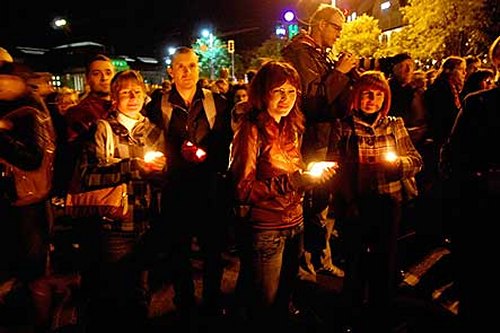
The peaceful revolution in Germany began in my hometown Leipzig, when the courageous parish priest, Christian Fuehrer, opened up a dialogue at the St. Nicholas Church with prayers for peace each Monday. They attracted large crowds – so many, that in time the church with its 2,000 seats could barely contain them.

From September 4, 1989 on the peace prayers resulted in the so-called Monday Demonstrations, with thousands of people holding candles, showing banners and shooting paroles. The authorities tried to check the demonstrations by means of road blocks and the presence of armed security forces in the city. However, the number of protesters steadily grew.
The government had given orders to shoot and the fear of an impending bloodbath was great. Nonetheless on October 9, 1989, on the all-decisive demonstration, up to 100,000 demonstrators showed up in downtown Leipzig – face to face with the 8,000 armed security forces deployed by the state, shooting in mighty choruses “We are the people” and “No violence” - an incredible and unforgettable experience!

What transpired would go down in history as the “Miracle of Leipzig.” Given the immense number of peaceful protesters, security forces did not dare to shoot. The demonstrations ended with a victory of the people over the authorities. Thus, the dam had broken. Protests quickly swept through the whole of East Germany, ultimately leading to the opening of the borders on November 9, 1989 and the fall of the communist regime.

Thursday, December 5, 2013

George Walker Piano Sonata No. 2


George Walker, composer and pianist

I Theme and Ten Variations
II (@ 02:43) Presto
II (@ 04:00) Adagio
IV (@ 08:00) Allegretto tranquillo

I love this sonata and this is, by definition, a definitive rendition of it. I mean, he's the composer and a very fine pianist.

Bollocks From The Freedom From Religion Website

Note:  I see in the paper that it's the anniversary of Mozart's death.  Here's a re-run for the occasion.

On this date in 1756, Wolfgang Amadeus Mozart was born. Son of a Catholic musician, the child prodigy conducted his first original Mass at age 12 in Vienna, was later made a Knight of the Golden Spur by the pope, and was concert master to the Archbishop of Salzburg for many years. Accused of neglecting his religion, he resigned the appointment in 1781. Mozart joined the Freemasons, who were condemned by the Catholic Church, in 1781. Mozart refused to ask for a priest when dying. His wife sent for one anyway, who refused to attend. Mozart was buried in a pauper's grave without a religious service. Referring to the orthodoxy of his youth, he said: "That is all over, and will never come back. (Mozart's Leben, by A. Ulibichev, 1847, i, 243). D. 1791.

I think that inch for inch, this might be the most deceptive thing I've ever read about Mozart, apart from the fictitious play, "Amadeus". 

The first thing to note about this little bit of tripe claiming Mozart for the atheists is that he was known to be a Mason.   While there are conflicting sources as to whether or not a Catholic in Vienna could manage to be both a Mason and a Catholic, one thing, it seems,  wasn't possible, to be an atheist and a Mason.  Atheists were explicitly barred from being a Mason.  You would have had to believe in the creator of the universe, a designer of the universe, to have been a Mason.  Some of the sources say that the ban on Catholics joining the Masons wasn't promulgated in Austria until the year after Mozart's death.  I have been unable to find verification of that.

While Mozart might have had his differences with the Catholic Bishop of  Salzburg, for the record, he quit the gig with the Bishop to run away to Vienna.  He was repeatedly away from his post, touring, which is what he was accused of neglecting.  Far from getting canned, the Bishop was not very happy to have his resident prodigy take it on the lam and rather belatedly fired him and, to express his unhappiness, his father, Leopold.  Though apparently Leopold kept his job, in the end.

Why would young Mozart want to leave? 


Salzburg is no place for my talents. In the first place, professional musicians there are not held in much consideration; and secondly, one hears nothing, there is no theatre, no opera; and even if they wanted one, who is there to sing?
Wolfgang Amadeus Mozart to his good friend, Fr Joseph Bullinger SJ  (Summer 1778).


As for the death and funeral of Mozart, so many myths has been told about it that it's very difficult to get any kind of accurate picture of what happened.   Two things are known, he had a funeral at St. Stephen's Cathedral and a Requiem at St. Michael's Church. 

In 1791, the year he died,  Mozart had been appointed assistant organist at St. Stephen's so his relationship with the church couldn't have been all that bad.   The story about a priest refusing to give him the last rights would seem to originate with his sister-in-law Sophie, (I believe she was there at his death) and Constanze, his widow's second husband G. Nicholas von Nissen, who said he had received extreme unction. [see update below]  Which I was taught comprised the last rites.  His burial in a "common grave" (that would be a grave of a commoner, as opposed to one where the myriad of aristocrats in the city would have been buried, not a mass grave) was in accordance with local customs.  The idea that Mozart "refused to ask for a priest" would seem to be an exaggeration.  From what I've read, all that is known is that Mozart doesn't seem to have asked for a priest.  Given the descriptions of his physical and mental condition, his desperation to complete the Requiem Mass he was working on, he might well have not been in any condition to have accepted it was time.   Apparently the evidence from his sister-in-law is that one came and gave him the last rites.  Though, like so much to do with that day, it is ambiguous. 

Given the amount of religious music, both Catholic and Masonic, that Mozart wrote right up to the day of his death, for atheists to claim him as one of their own is pretty silly.   While his letters don't seem to contain a lot about his developed thoughts about religion on the cusp of middle age, some of what he is known to have said probably wouldn't be very welcomed news for atheists.


I must give you a piece of intelligence that you perhaps already know, namely that the ungodly arch-villain Voltaire has died miserably like a dog, just like a brute. That is his reward! 
Wolfgang Amadeus Mozart - Letter to Leopold Mozart (3 July 1778)

I have been unable to make any sense of the last sentence from the Freedom From Religion Foundation.   Looking at page 243 of Ulibichev's book, I find a rather nonsensical letter to a friend.   Another book translates it:


To Herr von Hefner 

I hope that we shall still find you in Salzburg, my friendly slug. 

I hope that you are well and are not an enemy spider, for if so I'll be an enemy fly Or even a friendly bug. 

So I strongly advise you to write better rhymes, for If not, our Salzburg Cathedral will see me no more.  For I'm quite capax to go off to Constantinople, that city whose praises all chant. 
And then you won't see me again nor I you; yet When horses are hungry, some oats they get. 
Farewell, my lad, I'm ever to infinity 

Or else I'll go mad. From now to all eternity. 

As the previous letter on the same page in the book the FFRF cites contains the phrase "All good souls praise the Lord God", the idea that Mozart had become an atheist at that time is entirely absurd. 

In googling to find Mozarts Leben by Ulibichev, I found that this little passage has been adopted as fact all over the atheist internet, repeating the blatant distortions and errors contained in it.  Such has been my experience just about whenever I go online to research things said by organized atheism. 

UPDATE  What Mozart's sister-in-law Sophie and his widow, Constanze's second husband said in their statements is extremely confused and its interpretation by different scholars seems to differ.  Some read Sophie's statement as I first did, that the priest was slow in coming but eventually came, some read it to mean that they didn't come.   G. Nicholas von Nissen, Constanze's second husband, is translated to say both that that Mozart didn't receive last rites and that he received extreme unction.  Some assert that the priests might have been confused because Constanze seems to have wanted the priest to come but for Mozart to not understand he was there to give him the last rights.  From looking at various assertions about their accounts, it would seem that the nature of what is asserted depends largely on what other motives are held by those asserting it. 

What is clear is that by the 1820s when Sophie and Nissen were writing about the confusing night of Mozart's death, the lurid romanticization of the event was well underway. If you want a good idea at what a total mess the narratives  surrounding the death of Mozart are, this is an interesting paper dealing with just the medical theories and conspiracies invented to "explain" things.  About the only thing I'm pretty sure of, other than the documented facts,  is that, thanks to a second rate playwright what most people think they know, that Antonio Salieri did him in, is an absurd fiction. 

UPDATE 2.   This account of the funeral mass and requiem said for Mozart are far more detailed than what was known when I took a course in Mozart in the late 1960s.   It goes a long way to dispelling some of the more lurid myths about the days after his death, though it does little to clear up the actual night of his death.  The account by his friend, Benedikt Schack, of Mozart wanting to get together with other musicians to go over parts of the requiem eleven hours before his death is quite compelling.  I don't see any reason to not believe it.  It reminds me of the stories of how Alban Berg was caught up in his opera, Lulu, as he was lapsing into his final delirium and Bach dictating an appropriate chorale to his son-in-law.  Note the very end of the paper, where poor Sophie seems to be confused as to whether she went to St. Peters and St. Michael's church to find a priest that night, perhaps remembering the requiem sung for Mozart in her memory lapse. 

The picture of Mozart being surrounded by his friends and fellow musicians in the hours before his death is certainly more humane, though less romantically tragic -as if tragedy had to be heightened in this case - than the traditional stories. 

UPDATE 3.  One of the results of doing this day of research into the question has made me a lot more skeptical of the Mozart biography that is attributed to von Nissen.  It was, apparently, largely unfinished at his death, completed by two of his friends.  While von Nissen seems to have been making a real effort at documentation, it's difficult to know how much of the ambiguity of the account of Mozarts death could have been the product of so many different hands being involved in producing it.  I sort of get the idea that the account might have been written by someone who wasn't familiar with the Catholic sacraments.

Also, the picture I have now of Constanze, Mozart's widow, is a lot more positive than the ditzy flighty songbird presented by a male professor during my college years.   She seems to have done a good job of managing the family finances, especially considering the debts that Mozart left.  She effectively promoted and preserved his music, and did a fairly good job of raising her sons.   How she might have seen or used the ridiculous romantic legends that began growing up around Mozart as soon as he died, I don't know.  I'm left imagining a lot of it must have made her discretely roll her eyes but figuring if she couldn't stop it she might be able to use it to the advantage of her family.  She became quite well off and took care of her sisters and reconciled with Mozart's sister, Nannerl  late in their lives.   I've got a lot more respect for her than I used to have.

Issues In Long Term Care Giving

The problem isn't whether or not you're going to burn out, you are.  The question is how many times you can burn out.  

We're still taking care of our very old mother.  She's able to tell us that she hurts and where she hurts and she knows who we all are now.  She's off of the morphine, which is a far more devastating drug than I'd been aware of before.  That was no picnic.  And she's down to three halves of a Lorazepam but only on her really bad days.   It's no fun, getting your very old mother off of drugs her incompetent doctor got her addicted to.   

She, a woman who worked in some of the most well known hospitals in Boston and Philadelphia during the period before and during the introduction of penicillin, "It was like a miracle, the first cases we used it on," someone who had complete faith in the medical profession, has been led to being a skeptical victim of it.  She has been trying alternative treatment, having some good results with some of it. That was something she was extremely skeptical of before this happened.   I am hoping she will recover enough to write about her experience.  She is totally disillusioned with the for-profit hospitals, the only kind around, these days. 

Anyone in a country where they're trying to make medicine more market based, beware.  What happens here is what they want to do to you. 


Monday, November 25, 2013

Leo Brouwer Un Dia de Noviembre


Tatyana Ryzhkova

You hear all kinds of interpretations of this piece.  I kind of chose this one at random from the ones I liked.

From A Virtual Life Observed

Facebook has probably divided more families and friends than living together.   Why in the world to people air the dirty family linen on it?

Considering how worked up people got over the NSA revelations (I'd always figured they were doing a hell of a lot more than that, and still suspect they might be) you wonder why there is so little said about people surrendering their privacy voluntarily and other people giving theirs away on social media sites.  This weekend,  I heard of yet another family bitterly divided by it. 

Saturday, November 23, 2013

Leo Brouwer Sonata


I posted a very good recording of this sonata last year but this is a somewhat different approach.   It's worth listening to as played by different artists.

Tal Hurwitz plays a guitar built by Andreas Kirmse

Friday, November 22, 2013

Charles Ives: Song for the Harvest Season

Charles Ives

Song for the Harvest Season

Jan DeGaetani, soprano
American Brass Quintet

Gerard Schwarz - trumpet, cornet and flugelhorn
John Eckert - trumpet
Edward Birdwell - french horn
Arnold Fromme - tenor trombone

Robert Biddlecome - bass trombone.

Slow Recoveries

Our mother is better but far from well.  One of our friends, who is a doctor, looked at things and said that the hospital nearly killed her, though not for attribution in a court of law.   She requires round the clock care so we're not getting a lot of extra things done.   Unfortunately, she has developed bed sores so there is also that to deal with.  But her doctor says there is nothing imminently life threatening in her condition.  

It's exhausting but it's a good reminder that there is no experience in life better than being able to do things for others.  Maybe that's the purpose of suffering, the answer to the problem of evil.  

Thursday, November 14, 2013

Frightening Episode In Medical Mismanagement

It's been quite the fortnight of medical adventures for me and my family.  The latest was a terrifying episode of our mother going from a fully conscious, rational person who could discuss her replacing the front door of her house sixty years ago, to being admitted to a local hospital for overnight observation due to severe sciatic pain, to having her sent home, against the advice of her doctor, quite literally delirious, irrational and in a state of severe dehydration.  We found out that the "Hospitalist" had given her Xanax for anxiety, on top of morphine for the pain.  Her medical records say, distinctly, that she should never be given Xanax, due to a problem with it when she was mis-prescribed the medication before.   She was in her mid-90s at the time and, as the doctor who got her off of it said, no one in her age group should be given Xanax.  

We've been sitting up with her round the clock, dealing with the delirious episodes, learning too-late that someone her age has to be constantly checked for urinary tract infections, dehydration and that you should always question when a doctor prescribes mind altering drugs.  She's made some improvement though she is far from lucid.  One of the definite statements she has made is that she doesn't want to ever go back to that hospital.  It is the first time in her life that I have ever heard her make a negative comment about the medical profession in any way.   

Needless to say, it has taken up most of my attention for the past week and put me on guard concerning my own condition.   I had never heard of a "hospitalist" before but, in her case, it is a doctor who looks out for the health of the hospital's bottom line instead of patient care.   

The next person I hear talk about tort "reform" might have to go to the hospital.  

Tuesday, November 12, 2013

That's It, No More Downloading Software or Updates

I just spent several hours trying to get rid of the putrid Sweet Packs zombie software that I got from a well known source that bills itself as "virus free".  I was trying to find a simple foreign language word processing program and that was the result.

I'm keeping a list of software that has given people these kinds of hidden add-ons. From my search of the problem I've seen some people advise against the quick "recommended" express type of installation but to laboriously go through the features you are downloading to see if you can avoid this kind of trash but I'm guessing even that is no guarantee.  I guess you get what you don't pay for.  I'd hate to have to give up open source software but I'm not interested in getting infected again.

For The Day After Veterans Day

Now that the wreaths are laid and the easy, inexpensive "honoring" of those the country uses in wars is done until the end of May, here is an outrageous story about how the military has been dumping the soldiers it disables with repeated deployments such as the ones that have become common since the invasion of Iraq and the war in Afghanistan.

Dave Philipps is a reporter at the Colorado Springs Gazette, located in Fort Carson’s hometown. He began to hear stories about soldiers like Jensen, and has spent months writing a series documenting numerous battle-damaged soldiers forced out of the military without benefits.

"If they kick out these soldiers in a way that they get anything other than honorable discharge, then they don’t automatically qualify for the VA [federal benefits for veterans]," Philipps said. "They get their education benefits taken away. They can’t even apply for unemployment. And so, they’re really left with nothing."

It’s called being "chaptered out." Soldiers may be discharged for reasons ranging anywhere from tardiness to substance abuse, and more serious crimes like assault. Many have been diagnosed with post-traumatic stress disorder (PTSD), and some also have traumatic brain injuries (TBI), both of which can influence behavior and judgment.

Philipps said the number of soldiers getting kicked out for misconduct has gone up every year since the war in Iraq began. Since 2006, 76,000 soldiers have been chaptered out, Philipps calculates.

"If you just look at the army combat post where the most soldiers are, the post that might be most affected by PTSD, [there is a] 67-percent increase," he told America Tonight. "So it seems to suggest that a lot of the misconduct is being driven by these constant deployments."

Read the story of Jerrald Jensen who enlisted at the age of 34 after September 11th, was sent to Iraq in 2006 and in 2007

his patrol was attacked, and an explosive blew off part of his face and pierced his body with shrapnel. Jensen still managed to drive away from the attack, saving his commander, before being shot in the arm and the back. That incident resulted in a Purple Heart.

Doctors had to rebuild his jaw with titanium. After two years and 16 surgeries, Jensen volunteered for a second combat tour, this time in Afghanistan. He was assigned to Bari Alai, a remote U.S. outpost that faced nearly daily attacks from the Taliban. Six months into his tour, he fell while running to a gun post and again broke his jaw.


Doctors did their best to patch him up, but half of Jensen's face was permanently numb, and he lost his remaining teeth. He felt he'd had enough. Soon, he was transferred to the Warrior Transition Unit, a special unit in Fort Carson, Colo., set up to help wounded active-duty soldiers heal and transition into civilian life.

Once there, Jensen told America Tonight that WTU commanders seemed bent on getting rid of him. He said they wrote him up for minor infractions, like showing up late to a medical appointment, or making an incomplete stop at a stop sign.

Then, on a routine urine test, Jensen came up positive for amphetamines. He had been prescribed the decongestant pseudoephedrine and narcotics for his injuries, which can cause a false positive, so he asked to be re-tested. Instead, WTU commanders told him they were kicking him out of the Army for what they called a pattern of misconduct.


Not only did the Army want to discharge him without benefits like unemployment or access to GI Bill money, said Jensen, they also wanted to give him a discharge that was other than "honorable." That would likely keep him from getting any benefits for the rest of his life.

Apparently the bean counters in uniform are looking for every excuse to dump the soldiers it uses up  just like those who work for insurance companies and the corporations who want to dump employees who they've injured or killed.  It is estimated that there here have been about 76,000 of these used up soldiers dumped this way since 2006.

This is a real cost of war, America, the war that so many of you support as long as it's not your sons and daughters, your sons and daughters-in-law, your loved ones aren't the ones doing the fighting.  

It should be a law that any congressional representative, any president and vice-president who votes to send Americans to war have immediately entered their children and eligible family members in a draft.  Any media figures and pundits who promote wars should be hounded out of the public if their families don't already have family members in the military, and I don't mean in state-side offices but in combat ready units.  Those who are of at least the age and fitness level of Jerrald Jensen should also be entered into this draft of the war mongers.   That's when we might avoid wars no one should believe in, when we can have even the slightest confidence that we aren't being led into another of the quagmires that the corporate media have gotten us into on behalf of the decadent corporate oligarchs, leaving the fighting to working class and poor people who they have such an easy time of dumping onto the garbage tip when they've used them up. 

Saturday, November 9, 2013

Mauro Giuliani Rondo op. 68 no. 2


This piece, posted here the other night, really caught my fancy, I think I'll find a guitarist and play it.   Here it is on a modern piano and guitar.    Giuliani was a pretty good composer.

Friday, November 8, 2013

Celebrating Pseudo-Scientific Doodley-Doo As If It Is Science

Ok, Google.  So, really.  In 2013, we're really supposed to think that Hermann Rorschach and his claim to fame are anything other than overwhelming evidence that materialism is as prone to generating the rankest of florid, absurd, superstition and that, unlike religion in the modern west, it can attain legal power through its pseudo-scientific assertions?

In my research into the prophet of 19th and early 20th materialist monism, Ernst Haeckel, I came across Rorschach.  He was one who sought guidance from the expert of scientistic German atheism as to whether or not he should pursue his interest in art or in "natural science".  I use the scare quotes because I won't honor either man or his product with the designation of science because they're evidence of the decay of science instead of specimens of science.  Haeckel advised him to leave art behind.  I assume, given it was the young Rorschach who sought out Haeckel in this regard that he shared his disdain of religion.  Rorschach published on the topic of religion, choosing to focus on the most atypical of bizarre cults, symptomatic of the mental illness of the leaders and those they gulled.  Which, one might suspect, made what they said about religion as relevant to most peoples' understanding of it as what the most insane of pseudo-scientists said about science told us about sane scientists.  Rorschach being one of those, both as a cultist of pseudo-scientific Freudianism and as an originator and practitioner of some of its most pseudo-scientific and unfounded nonsense.

I am pressed for time today or I'd go into the folly that a faith that every single aspect of the experienced universe fits into a neat scheme of materialist cosmology and the emotional necessity of such materialists to jam everything they come across into one, but that would take more words than I can spare just now.  The field of psychology and the related pseudo and ersatz sciences never fail to reveal how insane the results of that can be, when you look at it in light of the expressed materialist faith of its expositors.  But that will take books instead of a blog post.

The position of that materialist faith in our legal apparatus is the product of the desperation of dealing with those dangerously and tragically unable to function as rational beings, past the point of toleration.   That any legal use has been made of the assertions of psychologists, psychiatrists, etc. on the basis of their interpretations of what they have gotten people to say about ink blots us a troubling sign as to how irrational a faith in something asserted to be science can be.  It is as valid as the opinion of an entrails reader or an astrologer but with the pretense that it was ever scientifically validated makes it far more potently dangerous.  And that is only one of the absurdities of psychology that can literally mean life or death, freedom or incarceration under our scientific regime.