Thursday, January 1, 2015

More Boswell Sisters

Crazy People


What'd You Do To Me


Update:   Ah, bunky, there's a whole world of like and dislike that is indifferent to the status of things and attitudes among the stultified kewlified.

A hint for the hintless.    The kewl kids who sit on the front step worry about whether or not what they like is kewl with other people and their status by the rule of the kewl.   Someone who has opted out of the conformist world of the kewl, the cruel and those who worry about what "roools, man" can like things and music or not like them on their own without worrying about what someone else likes.   What we think is impinged on at no point by if something is kewl with you or not.  We don't even think of that or if you think what we like is kewl or not.   We don't even care when you tell us.

Update 2:   Translation: Not even if I were suffocating and they had oxygen in them.

The Boswell Sisters

Was That The Human Thing To Do


Shout Sister Shout


There'll Be Some Changes Made


The Boswell Sisters - The Music Goes Round and Around La Bolduc - Amateur Show


La Bolduc - Gedeon Amateur


My old friend who died last year laughed and laughed when she heard La Bolduc's satire on amateur show performances from the 1930s.   She said that song was bound to show up on one that year.   I post this in her memory with the Boswell Sister's version, the best one I know.

OK, just one last thing.... and when have you heard those words before?

I remembered this morning that I wrote on that topic before, and probably better.  But only because it's early on a holiday and most people won't read blogs today.


Sunday, May 20, 2007

And Now For Something Really Controversial

You might find it surprising to hear me say so, if you know I'm a native of Maine, but there are few things you can do that will get my back up faster than bringing up The Elements of Style, also know as Strunk-White. It starts with the second name, E. B. White, who many call the most prominent of all “Maine authors” was from away. The first thing of his I ever read was a story about the disasters that befell an island family. It embodied his famous style, simple, warm, sentimental, just skirting the cloying. But for a native Mainer it also embodied an amused and patronizing condescension that has plagued my people for as long as we’ve been the subject of reports sent to Boston and New York concerning the manners of the natives*. I don’t like E. B. White.

The matter of style, now, that’s something I don’t like for another reason. I’m not a trained writer. I’ve never really studied the craft of writing. You are getting it pretty close to how I’d say it if someone would let me go on without pulling the talking stick out of my hand. Needless to say, that’s never been allowed to happen in real time. I tried Strunk and spent a lot more time wondering where he came up with his unconditioned pronouncements and dicta on writing than I did in producing specimens as practice. And what might the results be if I’d practiced? Did I really want to write like White, an author I really didn’t see the point of anyway?

Last year I tried again. I got a book, cheap, published by a popular writers magazine and read through it’s advice on simplifying style. It looked mighty familiar and I remembered reading through one of Rudolph Flesch’s books. Which while more detailed and practical than the sage of Yale, wasn’t much less prone to arbitrary advice. I noticed that some of those sentences containing “fewer syllables” weren’t objectively better than the rejected alternatives. The newer book was largely cribbed from Flesch, though at a dollar from the remainders bin, I wasn’t out much.

I turned to technology and found out that the “Grammatik” feature of Word Perfect had tools to analyze your writing based on Flesh’s theories. You could see how your style matched Hemingway or Lincoln. I fail both tests, though I come closer to Lincoln, which is good. If White annoys me, I’ve never gotten Hemingway. It’s not just his homosexual-hysterical machismo, it’s that when you reduce writing to mono-syllables and sentences of five words on adult subjects the results tend to be entirely vapid. I’ve heard endless streams of praise for the Hemingway style, notably more florid than the model, but I’ve heard few people talk about Hemingway moving them deeply. Why he is more respected than Katherine Anne Porter is a complete mystery. I didn’t test my writing against the income tax instructions model, also provided in Grammatik. Income tax instru ...?

If you could last through that rant, you might want to read this column on the hot topic of adverbs. I don’t understand the fuss, considering that adverbs are probably the second most endangered part of speech, after prepositions. They’re being supplanted by adjectives at an alarming rate. Maybe Strunk is to blame. He hated adverbs.

Now! To your corners!

* My favorite Maine author is Ruth Moore, though I’m not from the coast or a New England Yankee. Sanford Phippen, another real Maine author, has written a lot about the colonial aspects of our literary and artistic culture and the way it thwarts native talent.

Wednesday, December 31, 2014

Further And Gratuitous Dissing of The Precious Little Book

Here is more on the wisdom of Strunk and White which we are supposed to genuflect before and kiss the hem of.

"Put statements in positive form," they stipulate, in a section that seeks to prevent "not" from being used as "a means of evasion."

"Write with nouns and verbs, not with adjectives and adverbs," they insist. (The motivation of this mysterious decree remains unclear to me.)

And then, in the very next sentence, comes a negative passive clause containing three adjectives: "The adjective hasn't been built that can pull a weak or inaccurate noun out of a tight place."

That's actually not just three strikes, it's four, because in addition to contravening "positive form" and "active voice" and "nouns and verbs," it has a relative clause ("that can pull") removed from what it belongs with (the adjective), which violates another edict: "Keep related words together."

"Keep related words together" is further explained in these terms: "The subject of a sentence and the principal verb should not, as a rule, be separated by a phrase or clause that can be transferred to the beginning." That is a negative passive, containing an adjective, with the subject separated from the principal verb by a phrase ("as a rule") that could easily have been transferred to the beginning. Another quadruple violation.

The book's contempt for its own grammatical dictates seems almost willful, as if the authors were flaunting the fact that the rules don't apply to them. But I don't think they are. Given the evidence that they can't even tell actives from passives, my guess would be that it is sheer ignorance. They know a few terms, like "subject" and "verb" and "phrase," but they do not control them well enough to monitor and analyze the structure of what they write.

You know, I think the only reason that book was ever influential was because White wrote about it in the friggin' New Yorker.  If he'd written it in an academic magazine published in Iowa or Arkansas it wouldn't have ever gotten off the ground.  Which proves only what a bad idea it is to base a nation's life of the mind on fashion as published in an overrated magazine that specializes in a particular, mannered style of fiction.   Only I think someone might have a stroke if I started making fun of the mandatory inclusion of brand names in fiction of a semi-cosy nature.   References to private schools and Ivy League universities. And don't get me started on condescending reference to rustics in my home state, colonized by such folk.

Update: The faulty memory of the Eschaton Brain Trust or Duncan's rump, as I'm coming to think of them.

My morning e-mail calls my attention to this little slam.

Avatar
Adam_Hominem  DWD • 14 hours ago
I think so. There are two things I remember about AM: 1)extremely disruptive, disruption for the sake of it, and 2) assuring us Bush would lose in 2004.
 • Reply•Share ›

AM, that would be me.  Well, back in 2004 I was a regular at Eschaton but I posted comments under a pseudonym back then,  I wonder if Adam can tell everyone what that was off the top of his head.

I also never assured anyone that Bush would lose in 2004.  It would be entirely foreign to my personality to assure anyone of the outcome of an election -  I would be certain that I'd be jinxing the Democrats if I said something like that and I was entirely unimpressed with the campaign of John Kerry, which I criticized for 1. being in the hands of idiots 2. weak in its response to the smears and lies, 3. having a candidate whose nomination I didn't support because I didn't think he could win.  I also recall, frequently, giving his nomination as an example of why the influence of New Hampshire by virtue of its status as the state that had the first primary was a bad thing since they've supported at least two very weak candidates who used that to go on to get the nomination only to predictably lose the election in the previous two decades.  If there is something I've been since my earliest conscious years, it's an opponent of the influence of the New Hampshire primary.

As to disruption, I've never disrupted anything without having a point to it.  That, at times, the point is nothing more than to point out what a bunch of slaves to conventional thinking the kewl kids such as at the Brain Trust are, doesn't change the fact that it's a point.   Why do you think I included those two empty idols with feet of clay, Strunk and White, in my off-hand post about resolutions?   I knew the kind of conformist mid-brows that would enrage and the effects of their  insipid, superficial thinking.

THOU SHALT NOT DISS STRUNK AND WHITE!


Here is how well those boys I offended by dissing Strunk and White,  Sim Man and Boy Thunder, follow their oracle Strunk and White. One of the more absurd and well remembered commandments in "The Precious Little Book" is 


DO NOT INJECT OPINION

I would not be injecting an opinion to point out that Steve Simels' one and only claim to fame IS AS A POP MUSIC CRITIC.   Make that 


A CRITIC
Not to mention what they do at Duncan's little weblog of OPINION.  And if you want to check out how carefully E.B. White followed his model's advice, just look to see how successfully he followed that dictate, himself.* 

As someone who writes a blog as a critic of the abject failure of my political side and trying to find the reason for that, the advice to not inject opinion is an invitation to not point out the problems of the status quo which has comprised that failure for most of the past half century.  Perhaps it was due to the influence of that dreadful little book in college frosh rhetoric classes during that time which might have accounted for some of that flaccid thinking and overanxious hesitancy, leading to political failure. 

Strunk's original and with White's amendments comprise little else than opinions about writing.   Some of it based on obvious ignorance of grammar, some of it rather laughably wrong as revealed in the very, sacred, book.  

Here's a good critique of the "Little Book" and its absurd influence,  50 Years of Stupid Grammar.  In just one of the examples of what's wrong with the book there is this analysis of their dictates on the use of passive voice:

What concerns me is that the bias against the passive is being retailed by a pair of authors so grammatically clueless that they don't know what is a passive construction and what isn't. Of the four pairs of examples offered to show readers what to avoid and how to correct it, a staggering three out of the four are mistaken diagnoses. "At dawn the crowing of a rooster could be heard" is correctly identified as a passive clause, but the other three are all errors:
  • "There were a great number of dead leaves lying on the ground" has no sign of the passive in it anywhere.
  • "It was not long before she was very sorry that she had said what she had" also contains nothing that is even reminiscent of the passive construction.
  • "The reason that he left college was that his health became impaired" is presumably fingered as passive because of "impaired," but that's a mistake. It's an adjective here. "Become" doesn't allow a following passive clause. (Notice, for example, that "A new edition became issued by the publishers" is not grammatical.)
These examples can be found all over the Web in study guides for freshman composition classes. (Try a Google search on "great number of dead leaves lying.") I have been told several times, by both students and linguistics-faculty members, about writing instructors who think every occurrence of "be" is to be condemned for being "passive." No wonder, if Elements is their grammar bible. It is typical for college graduates today to be unable to distinguish active from passive clauses. They often equate the grammatical notion of being passive with the semantic one of not specifying the agent of an action. (They think "a bus exploded" is passive because it doesn't say whether terrorists did it.)
The treatment of the passive is not an isolated slip. It is typical of Elements. The book's toxic mix of purism, atavism, and personal eccentricity is not underpinned by a proper grounding in English grammar. It is often so misguided that the authors appear not to notice their own egregious flouting of its own rules. They can't help it, because they don't know how to identify what they condemn.
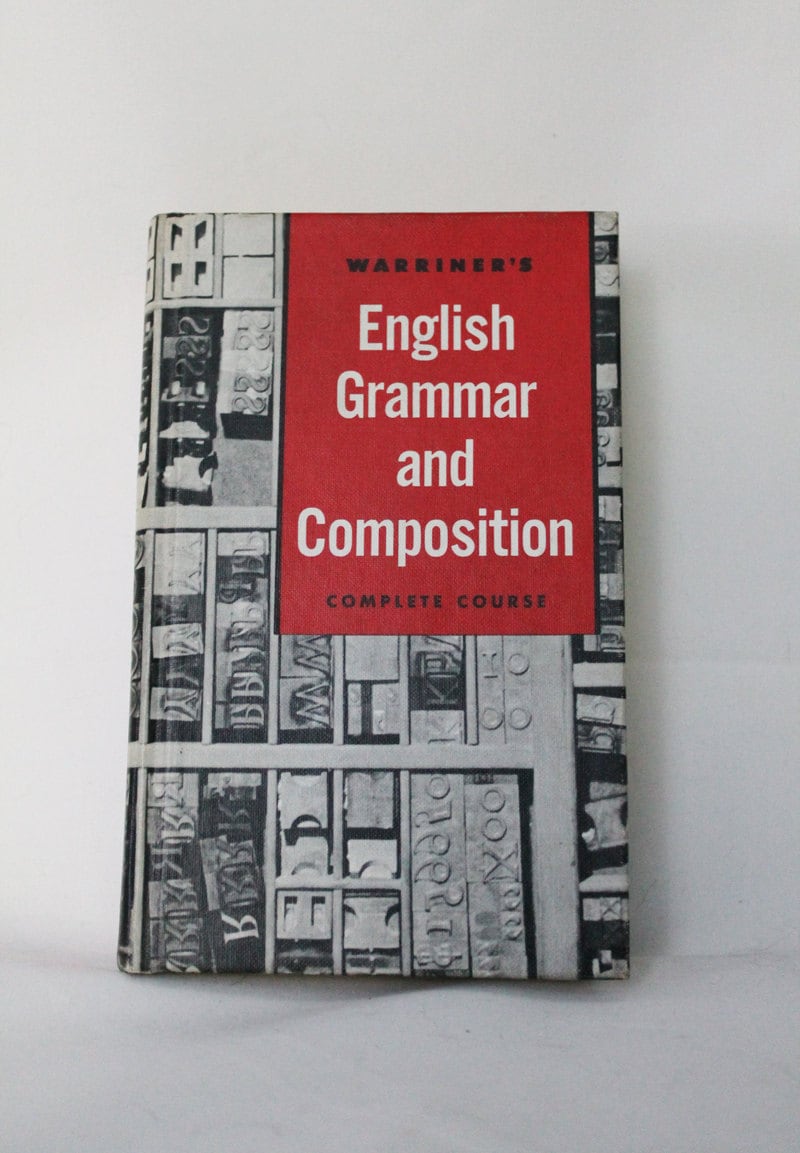
If I were going to go back and try to work on my writing I'd not cop out with that little collection of bromides, I'd adult-up and go through my old high school grammar, an earlier edition than that pictured above, or my antique copy of The College Handbook, which we were assigned in Freshman Rhetoric just as "Strunk and White" was beginning to replace real grammar texts.   Maybe in the new year, maybe not.  Unlike White or Simels, I've never made a penny from writing so I'm an amateur, which is my excuse.   It's not my day job. 
* As I recall the one and only copy of the thing that came into my hand carried the endorsement of the right-wing political hack James "Jack" Kilpatrick, whose career also shows how well he followed that dictate. 

Update:  One thing I can be confident of, the opinion of what I write interjected by Duncan's Brain Trusters will be based firmly on the basalt of never having read it. 

Resolution Dissolution Solution

One of the resolutions I've made in the past for this blog was to drop any mention of my tin-eared, tin foil but in looking at the stats for the blog, a number of you seem to like my little blog brawls - and here I thought I was making myself look cheap when I did it - so maybe not.  Neither do people seem to want me to stop criticizing icons of the would-be liberal mainstream.  Even the most sacred of those.   Nor do I think that I could do what I intend to while holding back on them.  

My perennial resolution, to edit better, hasn't taken yet, neither has my resolution to write fewer and more substantial pieces.   Luckily my former resolution to write shorter sentences and use a more elementary vocabulary didn't take.  I've come to the conclusion that simple style isn't suited for dealing with complicated or complex issues and ideas.   Most of the great examples of that kind of writing deal with quite simple and often simplistic stuff which tends towards the obvious.  I've come to the conclusion that reality is too complex to fit into simple sentences of simple language, no matter what the dreadful Strunk and White say about that. 

Resolutions are too important to only make them on New Years Day.   I make them on New Years, on the first day of Spring on my birthday (also in the spring) the equinoxes and solstices,  Labor Day, the beginning of Advent and several days in between those.  I find that making a resolution to start something on a Tuesday works as well as anything - mostly none of them do.  And I sometimes make the same resolution any number of times before it takes - a resolution would seem to take practice.  

One of the things I've resolved to do is post more on the topic of my competence, music.  For more of which, watch this space. 

Update:  Simmie and Thunderboy are outraged that I dissed the sacred Strunk and White, that's the way you know they're such counterculturey iconaclysmy types, their insistence on the sacred status of the dictates of the likes of those two bossy boots from the ivy league.   And have you ever looked at Simels' stuff to measure it against the commandments of The Little Book? 

La Bolduc - Le Jour de L'An


Your dad and I are going to get ready for New Years Day, I'm making some pies and an good old fashioned stew.

On New Years Day you shake hands and kiss, it's a good time to take advantage of, it only comes once a year. (after every verse)

Paint the sled and hitch up the mare, we'll go visit your sister down in the bottoms of the fifth (district).

Go buy a wig and put in your teeth,  it's true you've only got me to please but you might as well make yourself more appealing. 

Go be nice and invite your old Uncle Nazaire to come for New Years,  "Show your stuff , kick up your heels and dance like you did in your younger days". 

Try not to lose your head like you did two years back,  you only came to your senses when you ran out of money (I assume from buying drinks for everyone). 

There are those who'll raise a glass,  on the occasion of the day, though it's so expensive now and no one's working. 

Some smell of a pipe, some smell of onions but I'll tell you, most of them will smell like drink.  

(mis) translations are mine.
-----

One of my Quebecois neighbors wished me a Bon Jour de l'An this morning, reminding me that it's the real day to make merry, not Christmas.   Here's my one and only favorite song for the day sung by the incomparable La Bolduc in 1930. You can hear her complete works on the site at the link.


End Of The Year Fun UPDATES BELOW !!!!

A piece I once read about those snooty 19th century British travel pieces, talking about the Brits condemnation of American cuisine pointed out for Brits to critique the food of another country was like the blind proposing to lead the single-eyed.   William Cobbett, one of the most insightful critics of English society in the same period, attributed the dreadful state of the British diet to the class system and the hoarding of goods and their export by the aristocracy, something which, to a large extent, the Americans had avoided up till now, our putrid neo-Victorian era.  Perhaps the previous damage to the American diet was due to habits retained by those whose ancestors had been under that domination and deprivation, the present one is due to our copying some of their worst ideas.

Perhaps that is where one of the funniest videos I watched this year originated from, when Americans do taste testing of Australian junk food.


I did actually laugh out loud when I watched it, which led me to watch similar ones in the series, including when Brits got to try and be disgusted by American junk food, some of the worst on the planet.   If you want to see how horrible, here's this review of this years atrocities.   The only one of these things I ever tried was Vegemite which is pretty awful and which set off my yeast allergy.  I had to take an antihistamine tablet.  Having once used brewers yeast daily (whence my allergy) it doesn't have to taste that disgusting.  Perhaps they feel the need to make it disgusting out of principle. 

The one where Americans try Indian junk food was especially funny when they looked at the ingredient and saw "moth flour" listed.  That would be "moth bean" flour, not milled moths.  If they want to introduce it here, they'll have to call it something else. 


Now, isn't that more fun than watching the stupid ball drop while some drip croons "Imagine" instead of Auld Lang Syne?

Update:  Fair is fair, though I think the Brits are way too polite, here they have American junk food inflicted on them.


And if you thought it couldn't get worse, what looks like the engineers got creative in the kitchen after they dropped some acid. 


And this speaks for itself.


Carla Bley - Jesus Maria - Jim Giuffre 3


The cut I posted yesterday, on the great album, Dreams So Real (which you should buy) is followed by Gary Burton playing a solo version of "Jesus Maria" which is one of the really great jazz solos of all time.

Here's an also great trio performance of the piece by artists who should be remembered more.  I might be right that the bass is played by Steve Swallow, one of Carla Bley's longest standing collaborators and friends and the piano is by Paul Bley, who was once her husband.

The Faith of Atheists Is Why They Can't Face Reality And Why Information Exists Only When Minds Are Being Informed

Since my research into what made the so-called left fail has led me into a confrontation with materialism and its conjoined twin, atheism, I've learned a lot of things about the philosophy of science which are well known to a few who have had to go into that for their work, mostly physicists, but which is entirely unknown to even many scientists considered to be quite brilliant and capable of sophisticated thought.  Even some physicists seem to be rather startlingly naive about exactly what it is they do and even the simpler consequences of some of the most obvious facts about their field.

I have boasted several times about when, in a discussion about the incredibly short-sighted and massively arrogant idea that physics and cosmology were at the advent of having a Theory of Everything, I got one of the more arrogant physicists of our time, Sean Carroll to admit that science didn't even have a theory of everything about a single object, not even an electron, never mind the entirely more complicated entire universe.   And it was like pulling hen's teeth to get him to admit it.  Yet I believe the guy is still trying to sell the equivalent of hen's teeth rather successfully to the true believers in and out of science.   That is unless he has done the typical thing and bailed, using the golden parachute of anti-religious propaganda to tide him over in retirement in lieu of starting an antique shop.   Well, considering the recycled nature of the entirety of neo-atheist invective, perhaps that's exactly what you can call that.

The fact is that physics and cosmology are no closer to having a theory of everything than they were a thousand years ago.  In fact, the findings of physics, mathematics and logic early in the last century have, if anything, made the disbelief in the possibility of them ever having a theory of everything something of a reliable certainty.  The belief in the possibility of having a theory of everything would seem to fly in the face of  "laws of science" and even the equivalent in mathematics.    Yet such a thing is entirely respectable among exactly those who blow a gasket if someone questions something which is entirely more uncertain and even doubtful, such as I also did recently when I expressed my doubts about the reality of natural selection.  More on that in a minute.

One of the most shocking things I ever read about science was from a physicist, one who, in spite of what he obviously know about the unlikelihood of coming up with something like a theory of everything, fell into the trap of trying to find a shortcut to one, his Fundamental Theory.  The brilliant astrophysicist, Arthur Stanley Eddington, said:

Eighteen years ago I was responsible for a remark which has often been quoted:

"It is one thing for the human mind to extract from the phenomena of nature the laws which it has itself put into them; it may be a far harder thing to extract laws over which it has had no control It is even possible that laws which have not their origin in the mind may be irrational and we can never succeed in formulating them."

This seems to be coming true, though not in the way that then suggested itself. I had in mind the phenomena of quanta and atomic physics, which at that time completely baffled our efforts to formulate a rational system of law. It was already apparent that the principle laws of molar physics were mind-made — the result of the sensory and intellectual equipment through which we derive our observational knowledge — and were not laws of governance of the objective universe. The suggestion was that in quantum theory we for the first time came up against the true laws of governance of the objective universe. If so, the task was presumably much more difficult than merely rediscovering our own frame of thought”.

Since then microscopic physics has made great progress, and its laws have turned out to be comprehensible to the mind; but, as I have endeavored to show, it also turns out that they have been imposed by the mind — by our forms of thought — in the same way that the molar laws are imposed…

A. S. Eddington The Physical Universe: The Philosophy of Physical Science

I ask you to imagine what would happen if you said that the laws of science are imposed by the mind, that the mind creates the structure and order which is the substance of science instead of it merely being like gold nuggets that were picked up off of the shore of a riverbed or mined in its raw state.  I don't have to imagine because if you point out the nature of scientific knowledge, that it is the creation of human minds, you will enrage the typical hearer of that idea.  It happened to me yesterday in that exchange about natural selection, which is a far more obvious imposition of order onto nature by human minds and culture than the discoveries of subatomic physics.  But I've gone into why I am skeptical of the idea in far greater detail than I can take up your time with today.

The reason I'm revisiting these topics is because I think I've realized something new about the consequences resulting from the character of the atheist framing of reality, apart from the naive and arrogant scientism I've concentrated on before.  I think there is something far more basically wrong with the entire enterprise and it hinges on the character of the materialism that underlies it.

Materialism is, as I've been pointing out, a monist system in which one essential substance is the ultimate reality of everything, the physical universe, objects and their movements, the forces that are perceived as a part of that reality but which are intrinsic to it.   A materialist or, in Carroll's name-change, "naturalist" or, in the denotation switch of others, "physicalist" will angrily admit to no possibility that there is anything else which is real which can be real or which ought to be real.  It is a closed system, even our thoughts are inevitably bound up in the nets of causality contained in the materialist monist system.  Like Biblical or Koranic fundamentalism, the proposal or consideration of nothing outside of its demanded monist system can be tolerated.

Just as a religious fundamentalist ideology will confront inevitable problems when it comes up against real life, apart from people who don't happen to believe in that particular monist framing,  materialist monism runs into some really bad trouble when it confronts reality.   Since just about every materialist is also a devotee of scientism, science being what comprises its official catechism of faith and the profession of its clergy, you have to pretend that science is not what it is and, also, that if science is, like everything else, merely the result of the combination of molecular precursors, it can't attain an objective view of the very thing that it studies.  That its claims to comprise truth depends on something else being there, otherwise it's just another result of physical precursors going through their paces.  Nothing else can be allowed to impinge on their central monism.   Unlike those other fundamentlisms, which hold that there is a supreme conscious mind which can intervene and change the typical operations of physical reality - such as the creation and freeing of other minds -  materialist monism, depending on the actions of material objects within the limits of causality, can only be true if it is also false.

If you want to enrage an atheist, point out that science has no disembodied existence but consists of whatever ideas scientists have in their head that they successfully sell as science to their colleagues.  Science has a merely contingent character, depending on the collective state of mind of scientists at any given time.  And, since scientists in good standing are hardly in uniform agreement, it is not any one thing, it is quite variable.  Despite those obvious truths, for these scoffing, debunking and deriding atheists, there has to be something which is "science" which has some metaphysical existence external of human minds, which is invisible, timeless, enduring and, most amazing of all, omniscient.  And they will maintain an angry insistence on this disembodied thing, "SCIENCE!" can both be absolutely and objectively true and, at the same time, be susceptible to falsification and overturning.   How it can be both at the same time is a question that is not to be asked.  I know from practical experience that it will enrage just about any atheist you ask that.

Neither are you allowed to point out the things held by scientists to be real which are, then, in the normal ways of science, found to be not real or at least unbelievable.  You can add in those ideas which are constantly being shown to have been mistaken or even the product of outright fraud which passed through the review of their peers*, undetected, which are unmentionable, though their detection and reporting and rejection are supposed to be intrinsic to the "scientific method" the origin of its reputed reliability and the proud boast of exactly the same atheist-ideologues who have pushed the same romantic view of science which depends on pretending that science is what science cannot be, even on its own terms.

So the materialist-atheist view of science is entirely romantic and unrealistic and self-contradictory.  But it goes much deeper than that.  The very same habits of thought which produce it also produce an even more bizarre concept of disembodied information, of which this imaginary thing which they hold to be "science" is comprised.

I have had a problem with the breezy way in which the word "information" is often used by people in cosmology and in other parts of science because one of the most salient features of information is that it informs minds.  I don't think there is any reason to think that you can remove the mind which receives and understands information from the concept of information and have the word retain any meaning.  Information doesn't just lie there as a potential to be picked up or not, it is created in the act of some mind or minds being informed of something.  It would seem that just those minds which are in the habit of believing that there is some unconscious property of nature which comprises information are also the minds which are in the habit of making believe science has some disembodied existence in some perfect state which contradicts their other faith statements about what science is, what doing science consists of and its claims to the faith and reverence of all of humanity.   Tempted as I am to bring up things like multi-universes,  the obvious product of atheist crusading as science, not of the observation of nature,  Boltzmann Brains and other such creations of these mocking materialists because I suspect they are all the product of the same wrong ways of thinking flowing from the basic and inevitable contradictions of their fundamentalist and monist faith in confronting the actual universe, I think I've used up enough of your time today.  Perhaps in the new year.

*  Considering its essential and formally demanded (though often less than rigorously insisted on and obvious liability to malfunction) act of review by scientists, the bizarre, disembodied, concept of science held by such atheists is amazingly superficial.  Who do they think does that review and how could the imperfections in thought and act by those mere human minds not determine the imperfect character of science which could not be better than the minds that went into making it?

Tuesday, December 30, 2014

Carla Bley - Ictus, Syndrome, Wrongkey Donkey


Gary Burton Quintet

Gary Burton (vibraphone)
Mick Goodrick (guitar)
Pat Metheny (electric 12-string guitar)
Steve Swallow (bass)
Bob Moses (drums)

This is one of my absolute favorite cuts on any record I've ever owned. three pieces by one of the most significant composers of my lifetime .  One of the few recordings I bought both on vinyl and on CD, every cut on it is great.

Gwendolyn Brooks Was An Important And Profound Poet And Better Than Those Who Were More Taught

Your provocative idea for Tuesday

I have been reading and re-reading Gwendolyn Brooks the last few days and comparing her work with some other 20th century poets I was required to read in high school and college and, hands down, she is more complex, more profound, more varied and more relevant and more incorrectly and unfashionably tragic* than just about all of them.  Even the ones who were non-standard, back then, like Anne Sexton, haven't aged so well, not to mention the Beats who were never as much to start with.   I recently looked back at some I was required to read.  Such as Archibald MacLeish, looking for a quote I recalled - couldn't find it - and was surprised that it seemed even deader than it did when I read it in my youth.  I recently heard Elliot Carter's early setting of Allen Tate, Emblems, and was likewise unimpressed with his work and wondered how his once glowing reputation held up.

That one poem, so frequently included in jr. high school lit books, We Real Cool, inevitably misread (and who could have suspected it was to be read with that rhythm) and which needed to be gotten more deeply than merely understood, and you'd have to have seen enough tragedy than you would at that age to get it. Which might account for why she isn't considered as great a figure as she really was.   There's nothing more deadly to a reputation than exposing children to work they're not ready for and so will think of the author as merely facile or obvious.  That people are still concerned with the same fatal and foolish coolness a half a century after she wrote the poem and the resultant death rate proves the profundity of its insight.

Though her gender, her color and her citizenship might account for why she isn't considered as important as so many authors who are far less substantial and technically proficient.

If that's not controversial enough for you, I'm going to finally get around to rereading Pearl S. Buck again.   I suspect there's a lot more there than you're supposed to believe.   And if for no other reason than that I'm sure it's a major transgression against intellectual fashion to do so.  If I find what I hope to, I'll violate the rules and post about it.  Here's something I wrote a few years back.

Sunday, August 22, 2010


What's the Real Right Way to Think About Pearl Buck [Anthony McCarthy]

By the time I was in college it was de riguer to think of Pearl S. Buck as a cultural imperialist and a hack writer, evidence that winning the Nobel for lit. was a sign of mediocrity -- In fact, the last time I remember hearing her mentioned in the media was exactly that point made by the late, alleged, Boston Radio intellectual, David Brudnoy.

I'd read The Good Earth in high school and a number of short pieces. Until I read Lu Xun, years later, those were about the only literature written by someone with an intimate knowledge of China available to someone growing up in rural Maine. And unlike Lu Xun, her observations didn't have to pass through the second hand of a translator to get to an English speaker.

Perhaps due to my own superficiality, her work didn't interest me enough, then, so that I read more of it. And by the time that the dictates of the real, right way to thinking about her work caught up to me. Other things might have seemed more important at the time.

Reading this column in the paper yesterday, it might be a good idea to look at her work again.

Strangled baby girls strewn across fields and eaten by packs of dogs. Pots of human excrement breeding disease. Grotesquely deformed girls’ feet bound to ensure male dominance. Women crying in the night for their lost babies. A white-skinned family in a region of China the size of Texas. A devout Presbyterian inspired by God at the expense of his wife and children to save those millions of souls. A mother, heartbroken by the loss of child after child to disease, who still found the strength to save her remaining children’s lives by inviting for a formal tea starving farmers set upon killing her family.

That is how Tom Matlack, Buck's great-nephew begins to set the scene of her early life. Unlike many of the, mostly male, writers on foreign lands, which they generally observed as adults, Buck grew up in the world she wrote about. She spoke the language. But her writing about that world she knew intimately is given a low status that than truly superficial observations of other writers about "exotic" lands is. You don't grow up in a place and see it as exotic. By contrast, her near contemporary, Hemingway, is like a travel reporter.

The rest of the column notes that Buck's development was anything but conventional. Her earliest life developed at the intersection of the life of the Chinese peasants, her father's extreme Presbyterian-missionary self, and her mother - who must have been in the throes of almost unbelievable conflicts between those two entities, herself. And as she grew up, those must have both shaped and conflicted with her own childhood and adolescent issues.

It was a life that, in comparison, despite the legendary tales of their great, mostly male, adventures, makes her more reputable peers seem unqualified to write about their subjects. Maybe the success of those writers wasn't due to the depth of their knowledge and perceptions, or even just that most of them were male, but in the fact that they could mirror the conventional thoughts of Western reviewers, critics, professors of literature and a population acculturated to that conventional way of thinking. That Buck had her greatest success with the general public instead of the cultivated tradition must mean something.

How truly different and harrowing Buck's childhood must have been. Consider how you would remember having these experiences.

As a young girl Pearl was left to wander the hillside, a blue-eyed alien in a foreign land, which was all she knew. Where other children might have made mud pies, Pearl collected the dead bones of unwanted female babies and gave them a proper burial. She had a special stick she used to fend off the dogs. She was drawn to funerals of the wealthier farmers who could afford them. Overhearing her Chinese neighbors talk about how the missionaries ground up babies’ eyes to treat disease, as just a little girl squatting in the weeds she spoke the truth.

“Everything you say is lies,’’ she told them in their own tongue, causing women to scream with fear at having seen the foreign devil. In a way, the body of Pearl’s work was an attempt to make the world see a deeper truth of the bones buried just beneath the surface.

You've got to wonder why Buck isn't given more respect, especially for her work in woman's rights and civil rights, as well as on behalf of abandoned children. Looks more worth while than boozing it up with the literary lights and other famous people.

* Ruby Dee, is the reader, I think.

I'm Unkewl and I'm Glad I Am

My short declaration to my fellow members of We, The UnKewl, got more notice than I expected.  It would seem that there are many of us who realize we're not in high school anymore and we can just ignore the kewl kids, even as they want to extend their adolescence into their senescence and to their final quiescence.  

There is something so freeing in realizing you don't have to carry the baggage of the kewl kids and that all you have to do is choose to be happy being the not kewl person you are.  Having lived in town with the people I went to school with, many of them, the kewl kids didn't reliably end up happy.  Some did, many are just as nasty and miserable as they always were only they don't have people who have to put up with it because they're not incarcerated in high school anymore.  

It gets better doesn't only apply to the condition of LGBT kids, it applies to everyone who was oppressed by the kids who sat on the steps and who, on leaving high school gets to choose to stop caring about the thoughts of the conforming, the cruel and the kewl.   Even a few of them grow up and leave it behind but I think the odds of doing that are in our favor, we never had any stake in the kewl racket. 

Monday, December 29, 2014

Scratch a materialist, you'll find Ayn Rand. 

Are you now or have you ever been a member of......

I suspended my practice off taking Sundays as a day of rest during Advent because 1. Sunday is so much a part of the structure of Advent, 2. there were so many settings of the Magnificat I wanted to post I needed the extra four days to do it.  I will be returning to taking Sundays off beginning next week.

I should deal with a question I'm sometimes asked, usually not in the form of that set question from the inquisitors of the House Unamerican Activities Committee but in the same uh, spirit, if you will.

"Are you a Christian?"

Such a simple seeming question but one which, if you answer it, will be wildly different things, depending on the concept of what a Christian is of the person who hears the answer.  These days, the person who usually makes that challenge, and it generally is, believes a Christian to be a right-wing, Republican, creationist who is a racist, hates LGBT folk and who is ignorant and a liar and everything uncouth under the sun.  Considering the mouth on most of those guys and their propensity to believe in and spread lies and nonsense as if it is solid fact, that is a hoot.  All of which makes a yes or a no a less than adequate answer.

In one interview Chris Hedges gave he pointed out that there was no Christian church whose definition of "Christian" he'd fit into.  In looking up that interview, I saw it was undated so I have no idea how it matches his recent decision to take ordination in a church, agreeing publicly with its code of belief.   In the interview, he pointedly says something that I can certainly agree with, so much of the doctrine is something he doesn't think is important.   He talked about the historicity of Jesus, saying that we had no historical evidence outside of the Gospels that he existed.  I'd point to Tacitus and possibly Josephus as additions to that but I do get Hedges point.  I'd point out that is, actually, more evidence than than we have for any definable version of Socrates.  Considering Socrates was a member of an aristocracy in a city whose aristocratic class left a considerable written record of the kind that the mostly peasant and destitute class from which Jesus came and in which he largely worked in did not, the scant evidence for what Socrates was and what he said doesn't seem to bother the same class who go into paroxysms of rage and derision when people accept the historicity of Jesus.   I think the clear set-up job in which Socrates seems to only talk to people who can't think their way out of a paper bag Plato presents is more of a problem for discerning a real Socrates than the inconsistent Gospels and other canonical texts do with trying to image an accurate Jesus.

I have no doubts, whatsoever, as to the historicity of Jesus and what his central teachings are and that they are right.  Also that he was a prophet in the same line with the other Hebrew prophets.  He was Jewish, that is about the most certain thing about his identity.  Those all important teachings include,  if you will be perfect you have to love your enemy and pray for him.  I am obviously in need of working on that one, especially when it comes to treating my opponents in argument without irony or derision when pointing out their lack of consistency or other violations of their claimed sci-ranger rules.  For people who get so hung up on the historical record of Jesus they seem to be entirely uninterested in their own historical accuracy, or literary accuracy, too, for that matter.  So, see what I mean about me needing to work on that one.  I doubt that my limericks are exactly in keeping, either.

Since the general accusation is that people believe in Jesus out of weakness, there is nothing easy about trying to live up to his teachings, you couldn't be rich and do it successfully, you will be guaranteed to have a hard life if you do, you can't maintain a contemporary sense of dignity and respectability if you do.  People who turn the other cheek and let themselves be taken advantage of, even not being able to keep their clothes from those who would have them from them are not people who are deemed respectable.  You couldn't be fashionable or chic or kewl and follow them.  No, there's nothing easy about those teachings, the opposite, in every instance, is easier and more instantly gratifying, the real reason that aristocrats and oligarchs have either had to pretend they weren't there, have academic scribblers invent loopholes for them or, in the Brit and other atheist type of practice, outright attack and vilify those who believe in them and things like the historicity of Jesus.   That is the actual motive of most of contemporary atheism and the reason that the PR of the neo atheism has had such approval in our thoroughly degenerate late-stage empire media.  They have the same goals.

I doubt that anyone has ever actually lived up to the doctrinal creeds of any denomination, I doubt every or perhaps even any Pope has believed, fully, in the vast official code of belief the Catholic Church has set out.  I doubt that even the greatest saints have managed to achieve the ideal of perfection that Jesus set out in his teachings.  So I have to conclude that among other things, a Christian is someone who has at the very least, articulated the intention of working on that and is putting in an effort. Under my definition of a Christian,  I guess I'm one.

-------

THE MIRACLE THING

When someone makes that challenge in the form of an accusation, that you are a Christian, one of the first things they'll bring up is The Virgin Birth.  Since I've just spent the better part of a month on the Magnificat, I suppose I've got to go into that again.  In terms of belief, I go both ways on The Virgin Birth, I don't happen to actively believe in it or think it's all that important to believe in it, nor do I have any particular problem with the possibility that it could have happened.  If someone could tell me why my belief that I am to do unto others as I would have them do unto me, what no less a figure than Jesus, agreeing with Hillel, said "was The Law and the prophets", depended on believing in The Virgin Birth, then I'd spend more time worrying about it.

About that point in the explanation your atheist who, atypically, has enough minimal knowledge will aggressively break in to derisively assert that human parthenogenesis is impossible, generally calling it "a proven scientific fact". Well, one thing I know when someone says something like that is that they weren't paying attention in high school biology class or they'd know The Virgin Birth isn't an alleged description of parthenogenesis because humans have X and Y chromosomes which determine sex assignment and Jesus was a boy.

More typically, the claim will be that believing in The Virgin Birth violates scientific law which, again, only shows that the person making that claim has little to no understanding of science, what it is, what it does and what it is for. I wrote an early piece going through why Richard Darwkins exposed just that rather shocking ignorance when he claimed that the question of The Virgin Birth was a matter for science to deal with.  It can stand for any claimed miracle so I'm just going to repost it right now.

Science Without Physical Evidence, Dawkins Brings Us Back To The Middle Ages.

"Did Jesus have a human father, or was his mother a virgin at the time of his birth? Whether or not there is enough surviving evidence to decide it, this is still a strictly scientific question." Richard Dawkins, quoted by H. Allen Orr in the New York Review of Books, Jan.11, 2007.

The first thing to notice about this odd passage is “Whether or not there is enough surviving evidence to decide....”. Why “whether”? It is an absolute fact that there is no physical evidence available.  None.  No medical records, not even skeletal fragments.  No physical remains of the woman or son or possible father in question are available nor is their possibly surviving lineage known. It's unlikely in the extreme that those will ever be identified.  Why try to obscure the fact that there is none of the evidence necessary to examine the question with science when it is indisputable that there isn’t?  So, Dawkins proposes examining the question scientifically without any physical evidence.  He proposes determining the paternity of a child without anything to go on, whatsoever.*

Perhaps somewhat more understandable, since it’s Dawkins, he says that you can deal with the assertion of something that is claimed to have happened miraculously, outside the usual order of things and exactly once in the entire history of the world in the remote past, with science.  With the claims made by those who believe in the Virgin Birth, even argument by analogy can’t address it. When an event is claimed to be unique, there is no possibility of making a comparison with another or even every other event proposed to be similar. Any scientific comparison with any other event would be irrelevant to the claims of a miracle unless you had physical evidence of it**

The total lack of evidence and the claim of uniqueness renders it clearly and most certainly NOT a question science can deal with.  And this from the Oxford University Professor of The Public Understanding of Science. Certainly among the first things to understand about science are when there isn't enough evidence to practice it and when there is. That is something that hasn't stopped Dawkins in the past, however.   His specialty, after all, depends on doing exactly that, making science out of a total lack of relevant physical evidence. 

Much as it must frustrate those who would like to deal with some religious questions with science, much cannot be. They might not like that fact but that is just too bad. When the physical evidence necessary to study those is lost to history or non-existent, that is simply impossible. Pretending that you can proceed without the evidence it is dishonest and, beyond doubt, unscientific. You can believe or not believe the claims but using the prestige of the name science to back up your assertions can be done honestly only under specific conditions. It also carries a serious responsibility.

No one has to believe in the Virgin Birth, this short piece isn't about that. This is about how one of the most famous and arrogant personalities of science can get away with saying something so stunningly absurd. With his status in contemporary culture, it’s just amazing that a person holding a position like Dawkins’ conveniently ignores something so basic to science.

If biologists are content with having Dawkins being the face of their science, they are exchanging short term glamor for long term problems. It is growing clearer that in the political climate in democracies that science can’t support the dead weight of extraneous ideologies unnecessary for it. I will make a prediction that you can check out later, if Dawkins truly becomes the face of evolution it will continue to face fierce opposition by many of those he insults gratuitously. Its research funding will not be secure. In the face of his arrogant condescension, a large percentage of the public will not understand the science or want to.

* While it might be fun to point out, going into the need to give God a paternity test only heightens the apparent absurdity of Dawkins claim that this is “a strictly scientific question. Science not only can't deal with these kinds of things, it makes a mockery of science to try it.

**. Your only hope to determine the accuracy of a claim of a miracle is to look at whatever evidence of the specific event is available and see if the claimed result happened. Modern claims of, for example, miraculous cures of physical diseases, could, very possibly, be investigated by science but only by examination of the physical evidence. Without that, science can’t be used to investigate the claim.

Sunday, December 28, 2014

How To Drive A Kewl Kid Krazy In The New Year

Refuse to care if you are called not kew-el, refuse to try to be kewl, be happy to not be kewl and let them know that you don't care that they think you're not kewl and that they tell the other kewl kids that you're not kewl.   Ignore the kewl kids and be happy being unkewl.   They just can't stand it when someone doesn't care about kewlitude.  

Be unkewl and totally happy.  It's the best revenge. It's a big world and no one needs to be oppressed by the kewl.  Do something unkew-el every day just to stay in practice. 

Bernardino de Ribera - Vox in Rama

Continuum

Mikolaj Zielenski - Vox in Rama 


Anonymous (XI-XII century) - Vox in Rama 


Ensemble Discantus

Emmanuelle Gal
Anne Guidet
Claire Jéquier
Lucie Jolivet
Brigitte Le Baron
Brigitte Lesne
Catherine Schroeder
Catherine Sergent


Dir. Brigitte Lesne

The Blessed Innocents, the infant boys slaughtered on Herod's orders in an attempt to kill the future king prophesied to be among them are commemorated in one of the more chilling of the days in the liturgical calendar.   That it comes three days after Christmas is something that I'd expect most kids brought up Catholic remember every year.

On Being Involuntarily Exposed To Two Hours of Singer Songwriter Stuff, Continuing On With A Theme

So, that's what the great folk revival of my young adulthood has come to?   Songs of Self-pity and other First World Problems?  

I absolutely hate my state's public radio stations "In Tune By 10" show.  It's so depressing to hear rich kids whine out their creations.  And I'm stuck in another forty minutes of it.  

Update:  I must have cursed myself by bragging that I had avoided hearing Elvis or Frankie singing any Xmas songs last week because now the radio is blasting out a John Lennon memorial medley of Beatles songs, including the dreadful, So This Is Christmas one.  I think I'll keep the radio off for the entire coming year.   I'm going to have to insist that the thing goes off immediately or no more help with the supper prep.  The mopheads, yech. 

From below

2 comments:

steve simelsDecember 27, 2014 at 11:02 PM
Thus proving you completely missed Tyson's point.

ReplyDelete
Replies

The Thought CriminalDecember 28, 2014 at 6:53 AM
Given a choice between getting a point from the Cable TV's and Seth Macfarland's idea of a genius and getting one from Isaac Newton, I'll take the opportunity to get the one from Newton.

Update:  And I did get Tyson's point which was to make some neo-atheist click fodder using Isaac Newton without taking into account the inappropriateness of  tacitly claiming a rather deep believer in God and The Bible as the property of atheists, entirely ignoring what he said on the subject because those moderny, sciency guys figure that things like historical and textual accuracy and relevance don't matter as compared to their ideological, attention-getting invective.  Tyson's only point was to generate a tiny little fix of buzz about himself, not Newton.   NdT is a minor figure in science who has made himself into a major figure in TV and is trying to further his media career by hitching his star to the clunky old junker of the old-new atheism.