Monday, August 24, 2015

Just Heard the Financial Report: Andrew Hill - Black Monday


ANDREW HILL piano
BOBBY HUTCHERSON vibraphone
RICHARD DAVIS bass
JOHN GILMORE tenor saxophone
JOE CHAMBERS drums

I Don't Care How Much They Complain I'm Not Posting Kenny G

Apparently one of the Eschatots called me a jazz snob.   Which is ridiculous, considering the other theme song of this blog.


Update from a low brow:  Simpels tells me that no one cares what I post, which is so convincing, isn't it.  I'd love you to show me how not caring about what I post is done, Simps.  Go ahead, show me what not caring looks like. 

Update 2:  To Simps a jazz snob is someone who knows the difference between a dominant seventh chord and a major seventh chord.  


Hate Mail - Thou Shalt Not Diss Britland

I once knew a wonderful woman, a very liberal Democrat, who was the wife of an Army captain.  She was, by heritage, Zuni, they had met while he was stationed in California, as a young man.  They lived in several places when he was posted in Europe, one of them Great Britain.   She told me that she'd seen poverty in a lot of places in North America, in Europe, in other places in their travels.  She told me that the worst poverty, the most grinding poverty she ever saw was in England, in the 1960s and 70s, after the Welfare State had allegedly replaced the Poor Law in the years after the Second World War.  She was led by seeing that to reading Charles Dickens, she probably knew more about his books, his life and the milieu of which he wrote about than some university based specialists.  I knew her quite well and knew her to be a very perceptive, very intelligent and minimally ideologically motivated person.  I'll take her word for it until someone shows me otherwise.   And she told me that about the time Margaret Thatcher was about to start tearing up the Welfare State.  I don't notice that anyone, Tory or "Labour" has put even that back in place. 

Clean Up Job

There has been some confusion as to the points I was making in my Saturday post, which seems to have gained some traction as it has an unusually large number of readers.

1. I wasn't giving a "proof" of the existence of God.  That so many seemed to believe that was what I was doing exposes an occupational hazard for someone who looks into these questions.  I absolutely believe in God, I do not try to offer proofs of God's existence for reasons which have nothing to do with the topic I was dealing with.  The problem isn't with God, it is with human limitations.

2.  I wasn't giving a "scientific proof" for intelligent design by God.  I don't know how much more explicit I could have been when I said two sentences into it,   

"I think intelligent design probably can't be addressed in any way with science, disproving it or confirming it.  It, like all other ideas, is rejected or accepted on the basis of non-scientific persuasion." 

 The entire point of the piece was that the alleged use of science to "prove" that there is no intelligent design is full of logical disconnects and folly.

Even to assert that science can show that there is no intelligent design of the universe, of life, is to misrepresent both the science that is alleged to do that and the nature of what the attempts to do that actually does prove, that phenomena could have been the result of intelligent design because any experiment any scientist does will be the product of an intelligent design.  That argument grew out of thinking about the alleged science of abiogenesis which has tried, experimentally, to show that life could have arisen spontaneously, without intelligence or intention.  That such scientists could claim that only shows that they willingly choose to ignore that their experiment was entirely the product of intelligent design and there is no way to remove those vectors from their work or its meaning, especially in their use of it.

3.  My illustration using natural selection showed that in two ways it, as well, could not be used to disprove intelligent design.

a.  As A. R. Wallace said, Charles Darwin, in order to come up with the idea used the intelligent design of human animal breeding as a form of what he proposed happened in nature, as well.  If that was the actual origin of his idea, I'm not really certain but it was certainly a major component in the idea.  He, furthermore, exposed the fact that the entire idea, in its Darwinian form, betrayed that component of intelligent design through the term "natural selection".   Wallace, the "co-discoverer" of natural selection pointed out that was widely noticed in the first years after it was introduced in science and as it was gaining influence, not by ignorant people but by "intelligent persons"  Notice how he put it, himself,

I have been so repeatedly struck by the utter inability of numbers of intelligent persons to see clearly or at all, the self acting & necessary effects of Nat Selection, 

"Self acting".  Even as he was trying to influence Darwin to cleanse natural selection of implications of intelligent agency being involved,  Wallace couldn't keep from implying it, himself.  He imbued Natural Selection with having a self, something which is done over and over again by the most rigid and fundamentalist atheist-materialist fanatics whenever they are talking about natural selection.   The idea, in itself, the creation by Wallace and Darwin of a force which is asserted to drive the origin of species, was, itself, a construct of intelligent design.  I have become entirely skeptical that any such one force exists in reality, I think it is an imposed framing required by the scientific community and educated, elite society, not anything real in nature.  I think its actual provenance is betrayed by how it is really thought of in use, in science.

b. That last point is also related to my other line of argument in this area, that Darwin's stated inspiration, the economic ideas of the Malthus, were, as well, imbued with intelligent designs of human beings misrepresented as aspects of nature.   That was something which was noticed by William Cobbett in his Advice To Young Men, of 1829 when he pointed out that Malthus mistook the law of Britain (and other places) for the law of nature when the law of nature would have quite the opposite effects that Malthus advocated.  Under the law of nature, instead of the poor being reduced in numbers through starvation and privation, as Malthus advocated, the poor would, as able, take the property of the aristocracy as they could, clear out all of the markets as needed, etc.

The audacious and merciless MALTHUS (a parson of the church establishment) recommended, some years ago, the passing of a law to put an end to the giving of parish relief, though he recommended no law to put an end to the enormous taxes paid by poor people. In his book he said, that the poor should be left to the law of Nature, which, in case of their having nothing to buy food with, doomed them to starve. They would ask nothing better than to be left to the law of Nature; that law which knows nothing about buying food or any thing else; that law which bids the hungry and the naked take food and raiment wherever they find it best and nearest at hand; that law which awards all possessions to the strongest; that law the operations of which would clear out the London meat-markets and the drapers' and jewellers' shops in about half an hour: to this law the parson wished the parliament to leave the poorest of the working people; but, if the parliament had done it, it would have been quickly seen, that this law was far from 'dooming them to be starved.'

c.  Marilynne Robinson, in her great, great essay, Mother Country, pointed out that the entire basis of Malthusian theory, was based in one of the longer lasting efforts at intelligent design, the British class system, with its enormous edifice of laws, institutions, customs and imposed habits of thought that successfully stole the entire land for the monarch, the landed nobles, the aristocracy and turned the common people of Britain into helots, beating that system into them so completely through everything from violence, fear of falling to the absolute bottom and shame that they were one of the most thorougly oppressed and habitually accepting of people.  Malthus, which Darwin incorporated in an inverted form into natural selection depended on a man-made design, the British economic system.  That Darwin and his first supporters were of the class that was a beneficiary of that system, so often expressed in a carefully managed way so as to produce a bubble of tranquility around its favored class with a grinding oppression and violence not always just beyond view, but utterly dependent on well managed violence and oppression thought of their habitual life as nature is certainly true.  As I said, Karl Marx, who had originally been enthusiastic about Darwin, no doubt as a support for materialism, reconsidered it and saw that that is exactly what Darwin presented as science (see the second footnote from Saturday's post).   Marx, whose prescriptions are a total disaster, was, never the less, one of the most gifted, if inconsistent, intellectual critics in Western intellectual history.  In that second analysis of natural selection, Darwinism, he was spot on.

Far from showing that species could have come about without design by an intelligent agent, what natural selection, as it was constructed by Darwin and others and as it continued within science, shows is that an imaginary force, natural selection, can be saturated in aspects of intelligent design unadmitted or unnoticed by the very scientists who want to use it to "prove that an intelligent designer isn't needed" for more than a century and a half.   I would like an explanation of how they can tease out the many aspects of intelligent design which the idea is made from in order to use it that way.

--------------------

The argument I got into in the comments over Darwin's eugenics is another matter, though related.  For any new comers to this blog, I did a long series of posts on that topic and revised them once.  I could probably write another series at least as long using material I collected in researching it and it's always dangerous to get me on that topic.

I will state that the case that Darwin was the inspiration of eugenics and that he supported it in its earliest stage, both encouraging its inventor Galton, promoting his early eugenics as hard science, as well as Ernst Haeckels' extreme eugenic conclusions, including killing of the disabled and asserting the beneficial effects of the extermination of named ethnic groups for the surviving people is so clear from reading him and his citations that that case is proved.

That his children, especially Leonard, and Francis Darwin, perhaps as much George Darwin, but also Horace as well as other members of the Darwin family and inner circle who knew him stated his obvious support for eugenics seals the case in a way that no one who never knew the man could honestly be held to disprove.

They had a standing, especially in confirming that what their father said, he really meant, that no one denying that but who never knew Charles Darwin intimately could honestly be said to have.  One of the Darwin children is not contradicted by the others on this point.  Any case exonerating Charles Darwin of being the inspiration of eugenics and a supporter of it which ignores both what he said and what those who knew him intimately said is not doing honest history, they are ignoring and distorting the primary documentary evidence for dishonest purposes.

Francis Galton named Charles Darwin's natural selection as his inspiration in inventing eugenics with the full knowledge and approval of Charles Darwin.  Nothing that any post-WWII revisionist can say can possibly overcome that evidence, no use of Darwin's own, pathetic escape clause about "aid which we must give" can overcome the many times more words he wrote as hard science. contradicting them.


Sunday, August 23, 2015

Andrew Hill - Dusk


Andrew Hill,  piano
Ron Horton,  trumpet
Greg Tardy: tenor saxophone, clarinet, flute
Marty Ehrlich,  alto saxophone
Scott Colley, bass
Billy Drummond, drums

Mistaking A Tiny Fraction of Self-Important People For The Entire Universe

I am warned that if I keep on the way I am,  being "totally unrealistic" that "no one is going to take you seriously about anything".

I don't know how reading what people said, believing they meant what they said instead of pretending that they meant the opposite came to mean being "totally unrealistic".   Back when I was in high school and they were trying to teach us how to write research papers, that was called "gathering information" which we were told was the only valid way to do expository writing.  What seems unrealistic to me is pretending that a scientist who is writing a book he intends to be regarded as science doesn't, actually, mean what the main thrust of the work says, especially since in other parts of the same book, in letters to his professional colleagues and others, he confirms what he really meant.  Not to mention that those who knew him, his contemporary colleagues, those whose work he, himself, cited as reliable science, his friends and families who did what no post-war revisionist ever did, talked to him, confirm what he said in his books as being his real and stated position.   What seems unrealistic to me is to take a single passage that is a complete contradiction of what he claimed as valid scientific conclusions as overturning the rest of his book, especially as, for the entire time he's issuing his escape clause, he is undermining what he says in it.

I don't know how taking the claimed methods and standards of science as being the only ones under which science is validly considered to be science is being "totally unrealistic".   If something gets to be called science as it violates those claimed methods and standards, then it is the claims that those are the actual methods and standards of science that are unrealistic because those can be abandonned and the results still get to be called "science" with all of the assumed rights and privilege of being considered reality and a basis for action.

As to "no one" taking me seriously, apparently in the context of the warning "no one" is that universe of atheists who may comprise as much as 3.5 % of the human population.  And I doubt it's all of the atheists, some of whom will not willfully ignore what I said but at least honestly consider it.  I could lose every single atheist and still have more than 95% of the human population that might take me seriously on things I might make sense about.  I'd rather take my chances with that 95% than with the entire population of atheists, especially those who insist on suppressing knowledge and reason in favor of their ideological line.  I am done buying ideological lines without fact checking and whenever they insist on lying and, most of all, covering up murders and oppression.  It's the greatest shame of my life that I ever bought the sob stories of the communists for even a minute, if I'd subjected them to the same skepticism I have capitalism, that would never have happened.

Politically, I've pointed out before, if liberals gave up all of the atheists who insist on being obnoxious to most people, especially the ones who insist on such insane ideas as driving all of religion out of public life, they would probably attract as many if not several times more people to either their side or who would consider the possibility of working in coalition with them but who won't do it while being insulted, ridiculed and harassed.

Saturday, August 22, 2015

An Answer

Before answering the one comment I got dealing with the question I asked yesterday, I should point out that I wasn't asserting the impossibility of science demonstrating experimentally that what they produced demonstrated an absence of intelligent design in nature was a proof of intelligent design.  I think intelligent design probably can't be addressed in any way with science, disproving it or confirming it.  It, like all other ideas, is rejected or accepted on the basis of non-scientific persuasion.

I was pointing out that when something is produced by intelligent design it merely proves it could be the result of intelligent design.  That proof would be as close to an absolute fact as science could produce, the assertion, then made,  that such an experiment demonstrates a lack of intelligent design is dishonest and an incomplete and incompetent analysis of what was done.  I was challenging anyone to show me why that wasn't the case.  I'd have to see the explanation of how an experiment could show a lack of intelligent design in producing an effect or what other proposed means of scientifically showing a lack of design was before I could accept it.

jdf1010August 21, 2015 at 8:09 PM

There's no perfect way to test if something is designed or not, but of course one can try to think up criteria for evidence of intelligent design, and then test to see if these criteria are met. Using human design as an inspiration (naturally), it's possible to come up with a list of aspects that seem to reflect intelligence and intention, such as economy, efficiency, symmetry, etc. 

I can think of a number of reasonable objections to this, the first of those is that the attempt would be arbitrary, open to the introduction of intentional - though never admitted to - bias and the results being declared to have a finality and reliability which they, of course, could not have because of the arbitrary and arguably biased criteria chosen.

I think this kind of thing is done all the time in the social sciences and in the invasion of those into the valid scientific study of evolution, especially since the introduction of Sociobiology and evolutionary psychology, which show all of those defects and some others, including the invention of "evidence" on the basis of absolutely no evidence since no observation or measurement is done before what is invented to substitute for them is then "analyzed" reviewed by people who are engaged in the same faux scientific method, published in journals and declared to have the reliability of genuine science, to be incorporated and held as a scholastic body of knowledge.   That such knowledge has, in the past, been shown to be unreliable will not be taken into account.

What would you consider to be some possible indicators of intelligence in design?

As science?  For a start anything done by science is absolutely known to be the result of intelligent design, science is an intentional invention of human beings, in the beginning coming up with criteria that would be reasonably certain to keep such biases as discussed in my last paragraph out of a body of knowledge about simple physical phenomena so that the results could be reasonably expected to be universally applicable and reliable in their application to produce effects.  Any application of those to produce effects is also absolutely known to be intelligent design, it is the basis of my observation that scientists and others can't, then, claim that the effects produced demonstrate the absence of intelligent design.   I don't think science can be used to test the idea of intelligent design.

The idea of human design is imposed metaphorically on nature quite often, and promptly believed to be not a metaphor but an absolute representation of the working of nature.  It would seem to be a powerfully seductive habit of thought as can, perhaps, best be seen in the universal adoption of natural selection as an explanatory idea.  The idea comes, in part, perhaps originally, from the design of artificial selection in animal and plant breeding which Darwin depends on to provide "evidence" that his mechanism of the creation of species is explained by natural selection. The conventional and required assertion is that natural selection dispells notions of divine intention in the phenomeon of life, which is best shown to be a rather plainly false assertion by how the idea, itself came about and was, from the beginning, used.

Alfred Russell Wallace, Darwin's "co-discoverer" complained that his choice of terms, related to the selection involved in animal breeding, gave rise to the inevitable implication of intentional design*,  Wallace was eager to cleanse Natural Selection of any hint of intentional design but I don't think that's possible because it is, in itself, a metaphor of human design. Yet it is constantly cited, conventionally as a "proof" of undesigned, random activity.   That assertion, made by the people who made it, Spencer, Galton, Huxley, Haeckel, etc. was always an irrational and ideological dogma which was not supported by the intelligent understanding of the idea but which became a conventionally required statement of materialist faith (see the extract from Wallace below and his whole letter at the link).

I will note in passing that I think Marx was correct in pointing out that Natural Selection was an illogical misapplication of Malthusian economic dogma which was based on the unnatural effects of human culture causing populations to increase whereas the food supply didn't.  He pointed out that Darwin, in inverting Malthusian analysis, imposed the British class system on nature**, another metaphor.   Marilynne Robinson*** and, more than a century and a half earlier,  William Cobbett, pointed out that what Darwin also relied on, Malthus, misrepresented an artificial economic system, as created by the British legal system, as a phenomenon of nature, the aristocracy and the monarchy having artificially created conditions that restricted the growing of food, notably in the theft of common land by the aristocracy for things like sheep farming, because feeding the new textile industry wool was more profitable to them than maintaining farmers which the law made their tenants through the intentions of previous generations of aristocrats instead of free people with access to their own property.   The tangle of human design in the entire field of biology can't now be used to deny the possibility of design in nature except by refusing to acknowledge the history of the ideas used that way and the fact that they are entirely reliant on models designed intentionally by human beings.

I think the irrationality of this situation is shown best in evolutionary psychology which proposes the study of behaviors in the remote past where 1. no observation of such behaviors is possible, 2. no comparison of animals exhibiting such behaviors and those which don't is possible, 3. there is no possibility of comparing their life spans, their success in reproduction and a comparison of the numbers of offspring in future generations, etc.  What is substituted for actual science (observation, analysis of data, etc.) is the creation of narratives OUT OF THE META-NARRATIVE OF NATURAL SELECTION, which is, in fact, no different from the creation of other creation myths, only, this one being without God, it is called "science" and conventionally required to be accepted as such. Even more absurdly, such stuff, created merely out of a tale created from natural selection is then used to support the validity of natural selection, as so applied.   As I recently bragged, I looked at one of the most famous of those  fables and found it didn't meet any of the criteria of science, it violated mathematical logic and, though constructed of conventional Darwinian assertion, it managed to turn a the classical Darwinian assertion of the way that eyesight and hearing evolved into a dysgenic feature instead of a positive adaptation.  It violated every single thing asserted about natural selection! Yet it has been taught to university students and read by readers as science for more than thirty years.  The fudging of the barrier between "real science" and "popular science" has been done as much by figures of science as it has by their scape goats, "science reporters" from what I can see.

I doubt that any attempt such as the one you propose could avoid becoming a similar matter of dogmatic adherence and it would be far better for science to be kept out of such arguments,entirely. That many atheists, materialists, "skeptics" have wanted to and successfully have used the name of science is unfortunate and, as can be seen in the Intelligent Design industry, their efforts are more than matched by those who want to use the name of science to support the opposite. Only the I.D. industry would appear to have more persuasive power than the atheists have, they should have been more careful in what they wished to do.  Their design in using biology to promote atheism would have seemed to be a faulty design.

So far, the evidence from biology doesn't seem to support intelligent design, if "intelligent" is to have any meaning.

I just answered that.

The only thing that seems to be supported is horribly unintelligent design, or else no design.

I can point out to you that the entire field of biology as a science would be impossible if that were the case, anatomy, biological systems in organisms wouldn't sustain life, reproduction wouldn't succeed, life would be crushed out of existence by hostile physical forces and random, chance events which are met constantly which endanger and often destroy life.  If the systems such an observation would have to rest on were so incompetently designed there would be no such thing as a trait that could be "selected for" no trait would work against such a barrage of constant threat, leading to no possible probability that one over another could be "selected" and no species evolve because the traits they possessed worked in nature.  And so it has seemed to most people, so it is asserted even by scientists who are, at the same time, denying that's what they're doing.   The position taken by you in that statement is generally hypocritically and conventionally stated by people whose every assertion proves that they don't really believe it, their entire scientific narrative would collapse if their ideological stand were rigorously imposed on it.

Perhaps physics is another story. There's certainly no hard evidence of tampering with the laws as we know them, but the laws are themselves quite elegant. 

Please just listen to what you said,  "no hard evidence of tampering with the laws as we know them" The question is using science to prove, or at least demonstrate a lack of intelligent design.  Such design would be executed on objects through forces, the very thing described in those "laws as we know them".   "As we know them,"  your're admitting it yourself, that the "laws" we talk about are a human attempt to understand the forces as applied to physical objects and entities.  If the proposal is that God created the universe as it is, what is stated in the opening sentence of Genesis, then, of course, that includes those forces and objects and whatever relationships involved that we can possibly study with science.  God wouldn't be "tampering" with anything, everything science finds, which is the typical operation of those forces on objects, would be part of that design.  I didn't bring up the question of "miracles", things that are proposed to violate or happen outside of the normal operation of the universe, but those things are found in science, itself, they are generally thrown out of the data because they don't fit the general trend.  But that's not involved in the problem I posed.  Science can be used to investigate some, hardly all, claims of miracles but only when there is physical evidence that is relevant to the claim and which is sufficient to test it.  Which is often not the way that debunking of claims is carried out.   I did say I was a stickler about the valid methodology of science when science is claimed to be present.

That life is often not to our liking, is often horrible, cruel and short is no proof of a lack of design by someone else.  Though that assertion is often angrily made. Our designs on animals are most often all of those to them but the design is there.   The Bible, those awful chapters and books that document catastrophes that come to the people of Israel - discounting the ones in which they are making excuses for their conquests of other people, what nationalist literature always has done - generally note that the catastrophes experienced were either due to them not following the design of God or that they found themselves, unwillingly or unpleasantly, in the midst of a larger design.  But that's a rather large topic outside of the question at hand, as well.  I will point out, though, that the conventional assertions of Natural Selection are based in the deaths, generally through being killed and preyed on, killed in some kind of struggle over food, space, other resources, and in a myriad of other equally horrible ways and, as long as God is not part of it, that's seen by many as being good.  The denial of progressive improvement through the deaths of the "unfit" being asserted in conventional biology is a bald-faced lie, it is asserted by the mainstream scientists beginning with Darwin and continuing up to those today.  That is something I've looked into in great depth.

In this case, God would be less of a puppet master and more of a computer programmer, setting up the rules of the universe and then watching it unfold (and, significantly, allowing a certain degree of stochasticity in the program).

I have dealt with the frequent mistaking of the human metaphor for the behavior of human thinking that computers were invented to be for a model of the human mind.  That mistake proves the incompetence of the person doing it, using a created metaphor, which is necessarily incomplete, arbitrarily defined and hardly comprehensive, as a model for the thing it merely imitates.  And I will be harsh because the use of computers as models of human minds is one of the stupidest current superstitions within science, one which would be prevented by such people being taught the very recent history of their field and that models of people and animals aren't the same thing as living beings.  The thinking in that kind of "science" is really no different from the thinking of a very young child that their teddy bear has a personality - one that is remarkably human.   Once you realize that, it's frightening how influential such thinking is among adults with power.

You, then, impose the whole thing on God who is certainly not a human being and is certainly not bound by the limits of human imagination and conventional expression within the milieu of current culture.  Human beings can discern what you, yourself, called "human design" often with absolute confidence, as I said.  I think our powers to discern the intentional designs of God are probably entirely inadequate.  It reminds me of the criticism that was made of the atheist attempt to come up with a substitute for morality, utilitarianisim.   The idea that human beings could discern which choice would produce more happiness for the most people, and so choose a course of action against another, is ridiculous.  Leaving aside the impossibility of measuring "happiness" or even defining it, the ultimate consequences of choices made by us are often unforseeable in our own lives, not to mention the lives of those in the future, even, at times, many generations after us.  An action taken by someone today might seem to produce moderately good results but in the future might bring utter pain and devastation to enormous numbers.  And the happiness of other species is generally left out of such considerations.  The human capacity for determining the results of our designs is so limited that the idea that we could see the non-human design of even a limited though far more intelligent being is ridiculous.  To think we could discern the subtlety of design which God could make is infinitely absurd, it would have to be made known to us through revelation, if even then, not through the human invention of science which can certainly not even deal with all of human experience.  Though so many are thorougly convinced that it can do what it certainly can't do, many of them scientists, many of them even philosophers who should certainly know the absurdity of that idea, even such as Bertrand Russell, who as a mathematician certainly knew that we know things which are not scientifically demonstrable.  Mathematics is known with a certainty that no science can be, though it, also, fails to produce total and absolute logical closure.


*  I have been so repeatedly struck by the utter inability of numbers of intelligent persons to see clearly or at all, the self acting & necessary effects of Nat Selection, that I am led to conclude that the term itself & your mode of illustrating it, however clear & beautiful to many of us are yet not the best adapted to impress it on the general naturalist public. The two last cases of this misunderstanding are, 1st. The article on “Darwin & his teachings” in the last “Quarterly Journal of Science”, which, though very well written & on the whole appreciative, yet concludes with a charge of something like blindness, in your not seeing that “Natural Selection” requires the constant watching of an intelligent “chooser” like man’s selection to which you so often compare it;—and 2nd., in Janet’s recent work on the “Materialism of the present day”, reviewed in last Saturday’s “Reader”, by an extract from which I see that he considers your weak point to be, that you do not see that “thought & direction are essential to the action of `Nat. Selection’.” The same objection has been made a score of times by your chief opponents, & I have heard it as often stated myself in conversation.

Now I think this arises almost entirely from your choice of the term “Nat. Selection” & so constantly comparing it in its effects, to Man’s selection, and also to your so frequently personifying Nature as “selecting” as “preferring” as “seeking only the good of the species” &c. &c. To the few, this is as clear as daylight, & beautifully suggestive, but to many it is evidently a stumbling block. I wish therefore to suggest to you the possibility of entirely avoiding this source of misconception in your great work, (if not now too late) & also in any future editions of the “Origin”, and I think it may be done without difficulty & very effectually by adopting Spencer’s term (which he generally uses in preference to Nat. Selection) viz. “Survival of the fittest.”

A. R. Wallace: Letter to Charles Darwin, July 2nd, 1866

**  I'm amused that Darwin, at whom I've been taking another look, should say that he also applies the ‘Malthusian’ theory to plants and animals, as though in Mr Malthus’s case the whole thing didn’t lie in its not being applied to plants and animals, but only — with its geometric progression — to humans as against plants and animals. It is remarkable how Darwin rediscovers, among the beasts and plants, the society of England with its division of labour, competition, opening up of new markets, ‘inventions’ and Malthusian ‘struggle for existence’. It is Hobbes’ bellum omnium contra omnes and is reminiscent of Hegel’s Phenomenology, in which civil society figures as an ‘intellectual animal kingdom’, whereas, in Darwin, the animal kingdom figures as civil society.

Karl Marx:  Letter to Engels,  June 18th, 1862

***  See her great and entirely neglected essay,  Mother Country, my nomination as the most criminally and tragically suppressed book of the past half century. 
Friday, August 21, 2015

Challenge of the Day

I really would like an explanation of how someone doing something through an intelligently designed experiment could rationally claim that their experiment shows that the same thing could happen without the intelligence or without the design.  I have no problem with people who don't believe that the universe or life was designed by or through intelligent intention, I have a huge problem with the claim that you can demonstrate that with science. 

As usual, if anyone does explain how that can be done and their explanation is logically coherent and honest, I will post it with attribution.  But it has to be honest and it has to cohere and not be just an assertion of ideological positions.  

Update:  Challenged of the Day

Well, I don't see that Sims has presented an explanation of how a scientific experiment can demonstrate that the result it produces could be done without intelligence or design, but I wouldn't be the first person to assert that he could be expected to have ever experienced the first or applied himself very hard to produce the second, any design he has being everything but a demonstration of intelligence.     Let me know if the more sciencey tots come up with something.  

Update 2:  Apparently Thunderboy (Sims' BBF since Gomez was banned, I think people go there to live in a virtual soap opera.) thinks I've got mad cow disease.  Which would be rather unlikely as I've been a vegetarian since September, 1969, before the Brits were stupid enough to take Earl Butz's advice about cattle feed, or so I recall reading.   Thunderboy, of course, didn't answer the question, either.  Which would have been far more impressive.  

Update 3:  Oh, I don't care much what Sims and the tots say about me, they're all bark, not bright. 

Instead of McBrien on Friday, A New President of the United Church of Christ Makes Some Wonderful Points

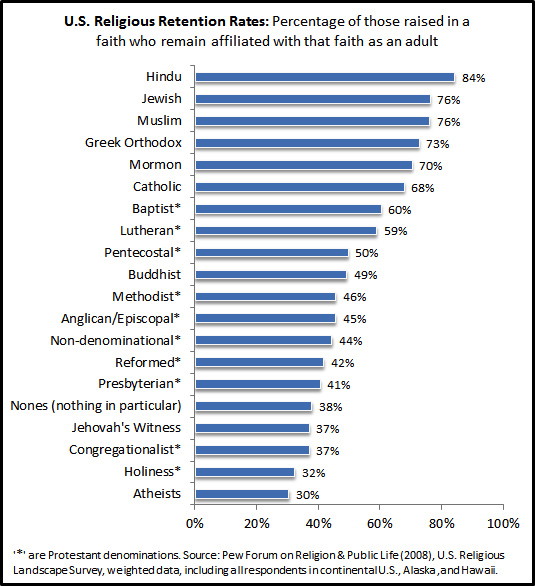
That graph I posted yesterday didn't exactly please me in some regards, the biggest of those was the figure showing that Congregationalists were losing the membership of their children at an alarming rate.  What's so alarming is that the Congregational Church has been one of the strongest forces in liberal social movements and politics for the entire history of the United States.  I can't see how anyone who valued economic justice, equal rights and the right of all people to a decent life in which they are respected for their full diversity couldn't be dismayed that the United Church of Christ would vanish or remain as a shadow of itself.   While it's true that there are other churches which have had a large role in promoting those things, sometimes with an impact far larger than their numbers would indicate, the Quakers being one of the most important of those, there is nothing good about that decline.

I hope that John Dorhauer, the new General Minister and President of the UCC, is successful in his intention to fix whatever it is that is hollowing out one of the most important liberal institutions and attracts new members committed to its justice tradition.  I do think that he is right, religion, especially liberal Protestantism, seems to be changing its form as fewer people go to the traditional Sunday morning services.

All this figures into what Dorhauer says will be one of the main themes of his presidency: to call the UCC to rethink itself and to consider new ways of “being church.” Postmoderns, he says, are less interested in institutional religion than their predecessors and tend not to be joiners but “samplers.”

“A whole new way of discovering the life of faith is emerging without the permission of or training required by the established church,” he writes in Beyond Resistance. “Those engaged in this faith exploration aren’t asking for permission.”

He doesn’t think what some call “the emergent church” will supplant the established churches so much as that the new will develop alongside the old for a long time. But he does foresee “mergers, partnerships, and downsizing as denominations realize over time that they are attracting fewer and fewer customers to the marketplace they currently occupy.”

Such transformations are not unique to the UCC or to even mainline Protestantism. Dorhauer thinks that most religious institutions are in danger of becoming “irrelevant” in the postmodern era. 

That is what I suspect is behind a lot of the unsubtle numbers in the Pew and Gallup surveys, the numbers that are often cited as representing a decline of Christianity and religion.  As an aside, It's possible to look at declines in church going or church membership and imagine people who leave one Christian denomination leave Christianity when that's not true.  It's not like the numbers of those who leave atheism because atheists who "leave" aren't leaving a church, they're leaving atheist ideology, you have to leave an absolutist position like atheism absolutely in order to leave it, there is no alternative atheism to remain in.

I suppose the question will be, well, if you think that way, why don't you join the UCC?  I did think of it, very seriously.   The nearest church to me, a town away, is a wonderful congregation that has one of the most active justice and social service ministries of any church in the area.   Maybe I'm just too Catholic to do it, maybe it's because I can't get used to the hymns.  If I did join I'd be more likely to participate in their meals program or their families of alcoholics support groups or one of their many other ministries than go to Sunday services.  I have a friend who isn't a member of their formal congregation but who participates in and contributes to those Congregationalist ministries, as do a lot of people, Protestants, Catholics and some Jewish folk who are involved in them as well.  I'd count that as a sort of participation in Congregational religion, certainly in that congregation's work.

Dorhauer talks a lot about that in the interview section of the article linked to above.

“Membership” as currently defined by (and deemed essential for) the institutional church will have no meaning in a postmodern, emergent world. People will belong in both an organic and fluid way to those groups or cohorts that provide their lives with meaning, that meet their spiritual hungers, that equip them to encounter the sacred, and that engage them in actions that effect change in the world.

People may actively participate in two or three such communities of faith. They may stay with one for a while, only to move easily and seamlessly into another for no other reason that it feels right to them.

In some ways, this reminds me of the descriptions of the earliest Church as described in Acts and the letters of Paul.  One of the big problems they faced were differences in what it meant to be a follower of Jesus, there were some disagreements about what was required and, in the case of Paul, suspicion about him from the leaders of the Church in Jerusalem, James and Peter.  One thing they were all unified in, though, was in their action for the poor, that was the one thing they demanded of Paul when he was going out on his extensive missionary work to gain converts, to remember the poor.  If the Christians of whatever churches or congregations or groups of the future do that, if they struggle to make equality and justice real in real lives, if they struggle against injustice,  they will have continued the very heart of Christianity, the very reason for it to exist, something that is generally not reported in surveys.

As a musician, I hope they keep the organs mentioned right after that in the interview, the tradition of congregational singing, as well.   Though that's merely an artistic hope.  The rest of it sounds like an excellent idea, to me.

They won’t be investing their missional resources of time, talent, and money in building and property, in sanctuaries adorned with stunning Tiffany stained-glass windows and nine-rank pipe organs and mahogany pews. They will meet wherever two or three can gather, and wherever the divine can be encountered they will be open to engaging that space and declaring it sacred.

The Tiffany windows, meh.  I like what The Reverend Ames said about the beauty of plain glass showing God's creation in Marilynne Robinson's Gilead.  And when his friend, the Reverend Boughton disdainfully said in Home, when he was shown the new Presbyterian church his congregation built after he retired with its stained glass about the Episcopalians winning.  If I hadn't lent my copy I'd find the exact quote.   Any church that can attract and keep one of the major intellectuals of our time, certainly one of our greatest writers, has something to offer.

That Dorhauer has announced that struggle against racism and privilege based in race, gender, etc. will be a main focus of his presidency, is wonderful as well.   The United Church of Christ has been one of the major and early institutions in that struggle and it continued in struggle for justice for  LGBT folk.  In the celebrations of marriage equality being achieved this year I couldn't help but note that even as that happened, racially motivated killing, by police, by armed vigilantes and groups of people were increasing and the media, especially the cabloids, were inciting it by promoting racism.  We've gone back to the worst part of the 1950s and 60s if not earlier as right-wing Republicans and others use racism to gain power.  That focus is both timely and a part of the perpetual struggle against evil, identifying it as evil, of sin is something that can be most effectively done in religion.

Hate Mail - THAT'S NOT FAIR! "You're an anti-atheist bigot....."

Um, hum, I see, and that would be because atheists are all about what's positive and wonderful about atheism, aren't they.   Let's look.  Here from the atheists at Patheos

Trending at Patheos Atheist


And those are the "Friendly" cuddly atheists who want to pin the personality disorder of a religious nobody on billions of religious folk who do not and never did have anything to do with him and never wanted to.   And there are hundreds and hundreds of them, most of whom don't make any pretense of being "friendly".   If it's not Josh Duggar it would be someone or something else.   The new atheism, the atheism you see every day, is only about one thing, being against religion, Christianity,  in almost all of its content, Islam a distant runner up, unless it's using the anti-Islamic stuff of some professed Christian to bash Christians universally.   And they don't even try to get their facts right or make a logically valid case in most cases.   

Let me guess, it was that last one about how most atheist raised children abandon atheism, wasn't it.  Something that's not supposed to happen, something that the narrative of atheist victory can't survive.   Well, live by the Pew numbers, die by the Pew numbers.   And I didn't even misrepresent the identity of the "nones" to do it. 

Thursday, August 20, 2015

Andrew Hill - Siete Ocho


Andrew Hill, piano;
Bobby Hutcherson, vibes;
Richard Davis, bass;
Elvin Jones, drums

Everything about this music is big even though there are only four players.

Since You Ask, Yes LePage is The Worst Governor Maine Has Ever Had. Most Mainers Voted Against him, Twice

I was sent this link and asked to comment on it. 

Maine, my home state, the state I've lived in my entire life, excluding a couple of school years during my college years, is not the liberal state a lot of people imagined it to be.  We have had some very good liberal politicians over the year,  Chellie Pingree is great, as was Tom Andrews during his brief career, only wish he'd managed to hold the seat but for every one of them there are at least five of the like of Dave Emery and Jim Longley jr.  We've elected some pretty awful senators, Olympia Snowe and Susan Collins, Angus King ain't exactly wonderful either.   And have had a long, long run of mediocre and awful governors, including Jim Jongley's father, Jim Sr. and Olympia Snowe's husband and former awful Congressman, Jock McKernan.  But none of them are as cruelly evil and just hateful as Paul LePage, the incumbant governor of Maine, the beneficiary of our ridiculous elections laws that have made it easy for spoilers to put in office terrible people.  He won, twice, through a combination of a millionaire egotist spoiler and less than stellar campaigns by otherwise good Democrats.  The loss of Mike Michaud after the loss of Libby Mitchell proves that our election system is seriously broken and will need to be fixed if such disasters as Paul LePage are to be prevented.  At the very least, no one should ever be able to become governor without getting more than 50% of the votes in an election, a run-off being automatic of no candidate gets an outright majority of the votes.  I would, as well, tighten up ballot requirements to prevent ego driven millionaires and those financed by millionaires in and out of state from being listed.  The idiotic ease with which candidates and ballot measures can be gotten on Maine ballots is one of the worst ideas of brainless "reform".   That it hasn't worked to get us better government proves it was a stupid idea all along.

Paul LePage is an example of a major party, the Republicans, putting all of the haters together and gaming the system to put truly evil people in office.  That many Republicans in the legislature and the state Senate, even some of those on the Supreme Court of Maine know that he is a stupid, mean spirited, hateful person who is driven by a desire to hurt people, especially poor people, and corrupt didn't keep them from retaining him as a candidate or supporting the one opponent in the last election who could have won against him.   It hasn't led to them - or democrats, for that matter - changing our election laws to prevent a repeat of this happening the next time a millionaire vanity candidate knowingly acts as a spoiler to put someone like LePage in office.  He has certainly not been over exposed by the Maine media, especially not the TV and radio stations, especially not MPBN, the allegedly public, actually corporate,  TV and radio alternative.  I don't even turn it on anymore.  Maine could be a test tube for what happens when media doesn't inform The People and, as a result, The People get lousy government.  

Democracy rots from the head down, the head being what has to know the truth for democracy to be possible.  The absurd libertarianism that has replaced responsible liberalism is where it all started to go wrong, those pseudo-liberals freed corporate media to lie us into oligarchy, here and everywhere. Nothing will change until we keep the media from lying us into oppression and, yes, you need regulation of broadcast and cable media to make them tell the truth.  You win with an effective margin of people, LePage won with an effective margin of ignorant, hateful people, people who brainlessly voted for him, they are the ones who govern us, not the majority who voted against him, twice.

Atheist Children Often Don't Remain Atheists

It is quite funny how unrealistic the thinking of most online atheists is.  They seem to think that the future is a sure thing for atheism, that it will increase the percentage point or two it has in the past decade and a half of it being promoted like a fad and that in a generation, as soon as the "millennials" rule, man, the world will be atheist and run things.  As I've noted, it looked that way to the Nazis too during the period when they not only controlled something like blog narrative and mid-brow culture, but also had control of the German government and military and required all German children over the age of 10 be part of its youth group and subjected to its propaganda, anti-Christian, as well.

I look at the "millenials" and expect they'll probably turn out to be about as predictable at 50 or 60 as the Flower Power cohort was not.   I expect they'll grow up, a lot of them, or just get older and nastier in about the same percentages as past generations.

The dreams of historical inevitability have been many and just about uniformly delusional.  The dreams of an inevitable atheist future are as old as scientism and the absurd and ahistorical belief that science was the property of atheists.  The difference today is, mostly, in the past the atheists pushing it had something like a real education, including history and, often, training in logical thought, something that is generally missing in most of those pushing that line today.  

In my time I went from being a rather serious Catholic, as a child, to being an agnostic for much of my adulthood to being a sort of Christian leaning freelance monotheist who is totally convinced of, not only the existence of God but also that God is concerned with us and our eternal souls in ways I was not, obviously, convinced as a pious child.  I didn't get there from reading less, by turning my mind off but by reading more.   One of the things I read - in response to a claim that Francis Bacon was an atheists - was his essay Of Atheism which contains the observation,

It is true, that a little philosophy inclineth man's mind to atheism; but depth in philosophy bringeth men's minds about to religion. For while the mind of man looketh upon second causes scattered, it may sometimes rest in them, and go no further; but when it beholdeth the chain of them, confederate and linked together, it must needs fly to Providence and Deity.

If "a little philosphy inclineth man's mind to atheism" the modern period proves that an absence of it can, as well.  That is other than the professional atheist philosophy profs who are as determined as the cosmologists I pointed to to force their discipline to become a weapon of their ideological atheist quest.  Listening to some of them in debate, reading some of them, they can seem as obsessed as Capt. Ahab, quite willing to wreck everything, including their field, including logical coherence, in their attempt to kill off their nemesis, in their case God.  

What inspired those thoughts is an article from last year that carried the bad news for atheists that children brought up in atheist households mostly don't stay atheist.  This graph was especially, well, graphic.


The first thing I notice is that this was the figure for the Catholic Church, from 2008, after three decades when of two of the most incompetent pastoralists of modern times had been pope and the devastating sex abuse scandal had led to people leaving in large numbers and churches being closed to pay compensation for victims who had and were suing.   And they still did more than two-times better than atheists in retaining the percentage of the next generation.   I will, also, note that it's not uncommon for Catholics to leave to become members of other, Christian denominations or just free lancers like me.  If the papacy of Francis will turn that around, if he will open the priesthood to married people, if he will correct the abusive centralization of power that played such a great role in the secrecy and cover up and protection of crimials in the clergy isn't knowable, though he has taken some steps in that direction.  If it would slow, stop or reverse the massive loss of people who identify themselves as Catholics has yet to be seen.   As ex-Catholics are one of the larger religious groups in the United States, these days, that could have a remarkable effect on future surveys such as this one. 

The article seems to me to try to give a best case scenario for atheists retaining people in atheism, which this certainly is not.  I've known of more than a few former atheists who became convinced of the existence of God as they get older, which was my experience as an agnostic but I think this kind of data forces a revision of the atheist conversion scenario, the great hope that education and the fashion push of the past twelve years will clinch the future for atheism.  That scenario is that someone learns about evolution and science (as if religious people don't know those things) becomes enlightened by it, rejects God and remains an atheist bringing up enlightened atheist children into perpetuity.  But that's a view of people derived from cartoons, not real life.  A lot of the atheism I see seems to be more likely the product of emotional damage, which could account for a lot of the anger and hatred among them.  Most of the rest of it seems to be based in the conceit and arrogance of people whose atheism is part of their acculturation into the common culture of university educated folk, an aspect of membership in what they believe is the elite they have joined.   I suspect a lot of the nastiness I've seen in atheists isn't kept out of the home and can't imagine a lot of them being very attractive role models for their children.  Atheism is an especially arid landscape, emotionally as well as intellectually, one that, apparently, doesn't impress many of those who have the greatest and most direct experience of it.  They bail in rather impressive numbers for something that is supposed to be the great hope for the future.  

St. Macrina The Intellectual

St. Macrina the Younger is someone who I've become a lot more interested in this year, unfortunately frustratingly little information is available about her or her thinking.   I'm unaware of any writings attributed to her. I got interested in her, first, for her opposition to slavery, her support for breaking down class differences and, later, for the universalism that was attributed to her, with some justification.  Most of the information we have about her comes from her brother, St. Gregory of Nyssa who, obviously, held her in the highest regard, both as a person of virtue and as an intellectual.   His account of a long discussion they had when he went to visit her and he found that she was dying might be the most substantial account we have of her thinking.  I started reading On the Soul and the Resurrection last night and finished it this morning and I'm struck by how it presents a direct opposite to the current propaganda about theologians and how the early Christians destroyed the imagined golden age of classical Greek and Roman intellectual life, a golden age which I don't find was recognized as such by the pagans of that period but which I know of mostly from the 18th and 19th century romanticized version of it.

I am finding that, not only were Macrina and Gregory quite cosmopolitan in their knowledge, pretty remarkable in that they were from a rather remote corner of the considered world.  I could also add that they were pretty sophisticated "for their time" but I think there wouldn't be too many people who have degrees from big name universities who could carry on a dialogue on the level presented in it, and who couldn't imagine it of someone like Macrina who hadn't been to college.   Here's a section that I found especially interesting.  I don't know Greek and can't know how closely the language follows it but I'd like to see it translated into modern English or a modern paraphrase that would contain the thinking of it.


Whilst I was thus enlarging on the subject, the Teacher [ What he, one of the major intellectuals of the early Church, the brother of other great learned intellectuals like St. Basil calls his sister, throughout the document!  So much for the universal misogyny imputed to the Church Fathers]  signed to me with her hand , and said: Surely what alarms and disturbs your mind is not the thought that the soul, instead of lasting for ever, ceases with the body's dissolution!

I answered rather audaciously, and without due consideration of what I said, for my passionate grief had not yet given me back my judgment. In fact, I said that the Divine utterances seemed to me like mere commands compelling us to believe that the soul lasts for ever; not, however, that we were led by them to this belief by any reasoning. Our mind within us appears slavishly to accept the opinion enforced, but not to acquiesce with a spontaneous impulse. Hence our sorrow over the departed is all the more grievous; we do not exactly know whether this vivifying principle is anything by itself; where it is, or how it is; whether, in fact, it exists in any way at all anywhere. This uncertainty about the real state of the case balances the opinions on either side; many adopt the one view, many the other; and indeed there are certain persons, of no small philosophical reputation among the Greeks, who have held and maintained this which I have just said.

Away, she cried, with that pagan nonsense! For therein the inventor of lies fabricates false theories only to harm the Truth. Observe this, and nothing else; that such a view about the soul amounts to nothing less than the abandoning of virtue, and seeking the pleasure of the moment only; the life of eternity, by which alone virtue claims the advantage, must be despaired of.

And pray how, I asked, are we to get a firm and unmovable belief in the soul's continuance? I, too, am sensible of the fact that human life will be bereft of the most beautiful ornament that life has to give, I mean virtue, unless an undoubting confidence with regard to this be established within us. What, indeed, has virtue to stand upon in the case of those persons who conceive of this present life as the limit of their existence, and hope for nothing beyond?

Well, replied the Teacher, we must seek where we may get a beginning for our discussion upon this point; and if you please, let the defence of the opposing views be undertaken by yourself; for I see that your mind is a little inclined to accept such a brief. Then, after the conflicting belief has been stated, we shall be able to look for the truth.

When she made this request, and I had deprecated the suspicion that I was making the objections in real earnest, instead of only wishing to get a firm ground for the belief about the soul by calling into court first what is aimed against this view, I began—

Would not the defenders of the opposite belief say this: that the body, being composite, must necessarily be resolved into that of which it is composed? And when the coalition of elements in the body ceases, each of those elements naturally gravitates towards its kindred element with the irresistible bias of like to like; the heat in us will thus unite with heat, the earthy with the solid, and each of the other elements also will pass towards its like. Where, then, will the soul be after that? If one affirm that it is in those elements, one will be obliged to admit that it is identical with them, for this fusion could not possibly take place between two things of different natures. But this being granted, the soul must necessarily be viewed as a complex thing, fused as it is with qualities so opposite. But the complex is not simple, but must be classed with the composite, and the composite is necessarily dissoluble; and dissolution means the destruction of the compound; and the destructible is not immortal, else the flesh itself, resolvable as it is into its constituent elements, might so be called immortal. If, on the other hand, the soul is something other than these elements, where can our reason suggest a place for it to be, when it is thus, by virtue of its alien nature, not to be discovered in those elements, and there is no other place in the world, either, where it may continue, in harmony with its own peculiar character, to exist? But, if a thing can be found nowhere, plainly it has no existence.

The Teacher sighed gently at these words of mine, and then said; Maybe these were the objections, or such as these, that the Stoics and Epicureans collected at Athens made in answer to the Apostle. I hear that Epicurus carried his theories in this very direction. The framework of things was to his mind a fortuitous and mechanical affair, without a Providence penetrating its operations; and, as a piece with this, he thought that human life was like a bubble, existing only as long as the breath within was held in by the enveloping substance , inasmuch as our body was a mere membrane, as it were, encompassing a breath; and that on the collapse of the inflation the imprisoned essence was extinguished. To him the visible was the limit of existence; he made our senses the only means of our apprehension of things; he completely closed the eyes of his soul, and was incapable of seeing anything in the intelligible and immaterial world, just as a man, who is imprisoned in a cabin whose walls and roof obstruct the view outside, remains without a glimpse of all the wonders of the sky. Verily, everything in the universe that is seen to be an object of sense is as an earthen wall, forming in itself a barrier between the narrower souls and that intelligible world which is ready for their contemplation; and it is the earth and water and fire alone that such behold; whence comes each of these elements, in what and by what they are encompassed, such souls because of their narrowness cannot detect. While the sight of a garment suggests to any one the weaver of it, and the thought of the shipwright comes at the sight of the ship, and the hand of the builder is brought to the mind of him who sees the building, these little souls gaze upon the world, but their eyes are blind to Him whom all this that we see around us makes manifest; and so they propound their clever and pungent doctrines about the soul's evanishment;— body from elements, and elements from body, and, besides, the impossibility of the soul's self-existence (if it is not to be one of these elements, or lodged in one); for if these opponents suppose that by virtue of the soul not being akin to the elements it is nowhere after death, they must propound, to begin with, the absence of the soul from the fleshly life as well, seeing that the body itself is nothing but a concourse of those elements; and so they must not tell us that the soul is to be found there either, independently vivifying their compound. If it is not possible for the soul to exist after death, though the elements do, then, I say, according to this teaching our life as well is proved to be nothing else but death. But if on the other hand they do not make the existence of the soul now in the body a question for doubt, how can they maintain its evanishment when the body is resolved into its elements? Then, secondly, they must employ an equal audacity against the God in this Nature too. For how can they assert that the intelligible and immaterial Unseen can be dissolved and diffused into the wet and the soft, as also into the hot and the dry, and so hold together the universe in existence through being, though not of a kindred nature with the things which it penetrates, yet not thereby incapable of so penetrating them? Let them, therefore, remove from their system the very Deity Who upholds the world.

That is the very point, I said, upon which our adversaries cannot fail to have doubts; viz. that all things depend on God and are encompassed by Him, or, that there is any divinity at all transcending the physical world.

It would be more fitting, she cried, to be silent about such doubts, and not to deign to make any answer to such foolish and wicked propositions; for there is a Divine precept forbidding us to answer a fool in his folly; and he must be a fool, as the Prophet declares, who says that there is no God. But since one needs must speak, I will urge upon you an argument which is not mine nor that of any human being (for it would then be of small value, whosoever spoke it), but an argument which the whole Creation enunciates by the medium of its wonders to the audience of the eye, with a skilful and artistic utterance that reaches the heart. The Creation proclaims outright the Creator; for the very heavens, as the Prophet says, declare the glory of God with their unutterable words. We see the universal harmony in the wondrous sky and on the wondrous earth; how elements essentially opposed to each other are all woven together in an ineffable union to serve one common end, each contributing its particular force to maintain the whole; how the unmingling and mutually repellent do not fly apart from each other by virtue of their peculiarities, any more than they are destroyed, when compounded, by such contrariety; how those elements which are naturally buoyant move downwards, the heat of the sun, for instance, descending in the rays, while the bodies which possess weight are lifted by becoming rarefied in vapour, so that water contrary to its nature ascends, being conveyed through the air to the upper regions; how too that fire of the firmament so penetrates the earth that even its abysses feel the heat; how the moisture of the rain infused into the soil generates, one though it be by nature, myriads of differing germs, and animates in due proportion each subject of its influence; how very swiftly the polar sphere revolves, how the orbits within it move the contrary way, with all the eclipses, and conjunctions, and measured intervals of the planets. We see all this with the piercing eyes of mind, nor can we fail to be taught by means of such a spectacle that a Divine power, working with skill and method, is manifesting itself in this actual world, and, penetrating each portion, combines those portions with the whole and completes the whole by the portions, and encompasses the universe with a single all-controlling force, self-centred and self-contained, never ceasing from its motion, yet never altering the position which it holds.

And pray how, I asked, does this belief in the existence of God prove along with it the existence of the human soul? For God, surely, is not the same thing as the soul, so that, if the one were believed in, the other must necessarily be believed in.

She replied: It has been said by wise men that man is a little world in himself and contains all the elements which go to complete the universe. If this view is a true one (and so it seems), we perhaps shall need no other ally than it to establish the truth of our conception of the soul. And our conception of it is this; that it exists, with a rare and peculiar nature of its own, independently of the body with its gross texture. We get our exact knowledge of this outer world from the apprehension of our senses, and these sensational operations themselves lead us on to the understanding of the super-sensual world of fact and thought, and our eye thus becomes the interpreter of that almighty wisdom which is visible in the universe, and points in itself to the Being Who encompasses it. Just so, when we look to our inner world, we find no slight grounds there also, in the known, for conjecturing the unknown; and the unknown there also is that which, being the object of thought and not of sight, eludes the grasp of sense.

I rejoined, Nay, it may be very possible to infer a wisdom transcending the universe from the skilful and artistic designs observable in this harmonized fabric of physical nature; but, as regards the soul, what knowledge is possible to those who would trace, from any indications the body has to give, the unknown through the known?

Most certainly, the Virgin replied, the soul herself, to those who wish to follow the wise proverb and know themselves, is a competent instructress; of the fact, I mean, that she is an immaterial and spiritual thing, working and moving in a way corresponding to her peculiar nature, and evincing these peculiar emotions through the organs of the body. For this bodily organization exists the same even in those who have just been reduced by death to the state of corpses, but it remains without motion or action because the force of the soul is no longer in it. It moves only when there is sensation in the organs, and not only that, but the mental force by means of that sensation penetrates with its own impulses and moves whither it will all those organs of sensation.

What then, I asked, is the soul? Perhaps there may be some possible means of delineating its nature; so that we may have some comprehension of this subject, in the way of a sketch.

Its definition, the Teacher replied, has been attempted in different ways by different writers, each according to his own bent; but the following is our opinion about it. The soul is an essence created, and living, and intellectual, transmitting from itself to an organized and sentient body the power of living and of grasping objects of sense, as long as a natural constitution capable of this holds together.

Can you imagine the big minds of our time being able to even follow what was being said?  If you presented something like this it would be dismissed as "word salad" without a single paragraph of it being understood.

I would be curious to know of any pagan document that treats the thinking of a woman this respectfully and wonder if anyone ever did a study comparing the pagan world's view of women's minds and thoughts with that of the early and even medieval church.  We are always getting the male chauvinists of that period presented as if they were the only people around when they weren't.  Clearly the universal disdain of The Church for women that is the common received belief is far from uniformly held.   I became interested in St. Macrina through looking at the primary documents opposing slavery last winter, I wonder what looking at the primary sources would show about where the idea of women's equality came from.  I have a feeling the glorious pagan world would come up short by comparison.  I would like to see an honest, honestly representative sample of each group of writers, the pagans and the Christians to see how seriously or often the minds and lives of women matter to them.

Wednesday, August 19, 2015

Hate Mail - I'm Not Making This Up, You Know

Proving that Duncan Black's readers don't even bother to read him, one accuses me of lying about him openly shilling for Jeff Bezos, wanting a cut from the horrible retail sweatshop that has made him a corrupt, politically corrupting zillionaire in the name of supporting Black's pseudo-leftist blog.  Here, I'll copy out the whole of the last time he did that, eight days ago.

TUESDAY, AUGUST 11, 2015

The Best Readers On The Internets
A bunch of people wrote in feeling guilty about their adblocker use and some even made contributions! Very nice. But I didn't mean to make anyone feel guilty about using them. I understand why people use them. Most sites these days have really awful horrible intrusive ads. You have to play 5 rounds of Where's Waldo to read the content and that's only if you can hear yourself think over the auto-on audio/video ads. Little sites like this which are more personal can't get away with running that crap because you'd all send me nasty email - justifiably! - if I did. And I don't want to run that crap. If it annoys me, I don't run it. I've experimented with very slightly annoying things in the past and promptly pulled them.

I was just lamenting the fact that internet bad actors - almost everyone these days - create a huge negative externality for sites like this. Every shitty ad is a nudge for people to start running adblockers. Even though my ads are fairly unobtrusive, people start blocking them too. It wasn't until recently that I started to notice a new trend in people using them.

But, anyway, the easiest way to "give" me money is to click on the amazon ads before you make purchases you were going to make anyway. I take a bit of money from Jeff Bezos, it doesn't cost you anything more, and everybody wins.

One thing that is notable is that this pathetic, pandering for a plutocrat, and himself, is about the longest thing that Black has done on his blog this year and was an answer to some responses to his whining that Ad Block was cutting back on his profits.  Other than things like complaining about the parking in his home town, it's hard to rouse Black to do much more than write a sentence or two about anything as he cuts and pastes stuff from other writers who bother to write.  And for that he's considered a major force on the left, there was such comment up at his blog just last night to that effect.

There was a time I bought the hype about such "new media" just as I'd bought the hype about the old media of the left.  Say what you will, at least the old media on paper delivered by unionized U.S. Postal Workers, sometimes had  reliable content and it tried to live up to some basic level of integrity.  The "new media" is your leftist principles as translated through slacker mentality and the program of liberalish-libertarianism.

I will take your typical Mennonite, United Church of Christ, Quaker, liberal Catholic, etc. blog, podcast or video channel as a place to stumble across actual liberalism now.  They have a real and deep motivation to try to maintain integrity even when their audience doesn't notice because they're too busy buying the image and congratulating themselves for it, their membership in the clique of the kewl kids.  They really believe it is a sin to tell a lie and they believe that knowing the truth will make you free.  It won't, though, be compatible with shilling for the likes of Jeff Bezos.

Science Cannot Be Done Without The Intelligent Design of Scientists It Cannot Disprove Intelligent Design But It Can Prove Scientists Can Claim Stupid Stuff

Last night I got a message that Duncan Black's Brain Trust was on me again, apparently it's something they do between discussions of their TV viewing, dinner menu,  and their self congratulations on how much smarter they are than 95% of the world and how stupid everyone else is. Who needs that kind of stuff once you're out of 8th grade?  That's what Eschaton has become, which is perhaps why its owner has been whining about its failure to make him money in such a pathetic manner.  Why he is shilling for Jeff Bezos and his retail sweat shop, wanting the pennies on the dollar he gets from the labor of those wretches..

Anyway, one of the "brain" trustifarians is someone so bright that she adopted the name of the Aztec goddess Tlazolteotl, who is famous, among other things, for being the shit eating goddess, the goddess that eats shit.  I know, why would anyone who had bothered to actually read about  the goddess, Tlazolteotl,  choose that for a blog comment name.   I may have been the one who first pointed out to her that it would give someone who she attacked, like me, the opportunity to say, "shit in, shit out".  Apparently, from what she describes, she's some kind of lab tech at some biology lab or something on the West Coast and so considers herself a scientist.  I'd like to see her publications list or her CV but this isn't going to be about her, it's about another of those things I wrote that gave me a lot of pleasure.

She claimed, last night to have driven me from the blog of Greg Laden, which is rather odd because that's the place I pointed out she'd said that Richard Feynman didn't know anything about science, [see last night's late post and this link].   Far from "driving me from" Laden's blog, that was the one and only discussion I ever had there because he quoted something I'd just said at another blog, unattributed, in the title of his post,  "We can know nothing about the origin of life, "  to which he began,  Falsehood!!!   I don't think I'd ever looked at Laden's blog before then and have seldom looked at it since then, it's one of the cookie cutter neo-atheist Science Blogs, which are pretty uniform and not that interesting.  The uniformity of such blogs leads to them being not worth revisiting if you're interested in more than the same old crap, but I don't want to make this about Eschaton, either.

The topic of the origin of life on Earth interests me mostly because the alleged science of it, "abiogenesis"  is a great example of a scientific field that was invented and continued as part of the ideological promotion of atheism.   From  Alexander Oparin, the first significant figure in the "science" up till today, the effort is to "prove" that life arose from non-living matter spontaneously, as a result of randomly assembling molecules and, somehow which I don't think has ever been explained, structures made of those molecules all without any help from the intentional actions of an intelligent being.  Which, if you stopped to think about it for even five seconds, can't be done with science since science can't happen without the intentional actions of an intelligent being.  Everything about the field of abiogenesis, the famous Urey-Miller experiment, the not exactly related determination of the structure of DNA* even the "creation" or perhaps more accurately recreation of DNA which can be gotten in a lab to replicate (in the popular misunderstanding of that molecule) which are claimed as milestones on the road to clinching the argument for atheism, is the product of intelligent design.

You can't do science that proves a result is not the product of intelligent design because science can only be done through intelligent design.

Unless atheists can find some way to do science without intelligence or designed experiments, that quest is doomed by its foundational disconnect from logic, which only proves that scientists on that particular ideological quest will be allowed to shatter the most basic of all requirements of scientific assertion, logical coherence.

Which was obviously why Greg Laden denied the hard truth about the origin of life that I stated when I said that nothing could be known about the origin of life, that is because we don't have the evidence that would be necessary to know what the origin of life on Earth was.

I happen to believe in the single ancestor of all life theory, though that isn't a scientific belief, it can't be because it is entirely unsupported by science but is an inference based on the obvious inter-relatedness of all presently known life on Earth. In that, and only that,  I'm a totally conventional Darwinist, as is virtually every atheist with whom I've gotten into this topic.  And I'm a stickler about the requirements of science, something which few of them seem to be.  Observation is especially necessary in the biological sciences, without the specific evidence of that, specific organism, unique in the entire line of life since it didn't come from a living organism, we can't know how it came to be alive, we can't know anything about its anatomy, its functioning its metabolism, how it sustained its life and, most remote from anything like knowlege, how it, almost certainly without precedent in Earth's previous history, successfully reproduced itself, producing one or more offspring without dying in the process.  How did it tear itself apart and heal itself, producing another, presumably like it in its biology and ability to sustain life in what became its habitat by its presence and, also, reproduce, without dying.  The naive answer, "DNA" is, itself an even larger hurdle because it is unlikely in the extreme that that molecule developed or became active outside of a living organism.   Answering "RNA" is no more of an answer to that question because the same problem of how such a complex, elaborate molecule and its more elaborate action in biology could have come about without cellular chemistry in a living organism produces unanswerable complexities as well.

I love it when atheists try to claim abiogenesis as being what it can not be unless the extremely unlikely happens, they discover and correctly identify that original organism, the very first one, the parent of us all in presumably fossilized remains that are resolvable enough to determine anything about them.   Which would, in itself, be miraculous as the closest thing like that we have is what must have been from hundreds of millions of (presumably) evolving years after that event and those are hardly resolvable in that detail and tell us nothing like a complete picture of life at that stage. Abiogeneis cannot be the study of the origin of life on Earth because there is no evidence on which to build science about the origin of life on Earth on.  Abiogenesis, as it is used ideologically by atheists is evidence that they tend to sacrifice rigorous thought and rigorous science in the interest of their non-scientific ideological beliefs and that they are allowed to get away with it because their belief is atheism.  It is only one of the areas in science where atheism has been allowed to do that, present day cosmology has been driven mad through that use of science, as well.   As, frequently,  have the social sciences, of which Greg Laden is a practitioner.

Here is a post I did in answer to one of the less stupid commentators at Greg Laden's blog so, of course, it wasn't Tlaz.  I would put a lot of it differently today because in the intervening four years I've come to see the kind of decadence Laden's POV imposes on science as being far more pervasive and far more dangerous to science and its use in the world.  Laden never did admit that my point about the lack of evidence was valid because to do that would be to admit that we can know nothing about the origin of life on Earth without that evidence and he was unwilling to be honest about it. The increased facility of lying is another thing I have come to conclude is another product of atheist promotion in science and in the wider society.   When you don't believe it is objectively wrong to lie, you will lie when you want to and you can get away with it.   Atheists are always being allowed to get away with it.

We Cannot Know About The Lost Past Without Evidence

For the past week I've been engaged in a long discussion at Greg Laden's blog about whether or not we could know anything about the origin of life, the way in which life first arose from non-living matter, what life was like and other aspects of that problem. Here is the link to that discussion for anyone who is interested in it. A long answer to Stephanie Z, one of my antagonists in that brawl has been caught up in moderation for a while now so I am posting it here and will attempt to notify her that it is here. Please note that, as in my argument with Sean Carroll last year, I've tried to get some questions answered by Greg Laden, so far he has been unwilling to respond to them. The last version of those were asked at comment #202 at the link, I will post them in a note after the comment 

Stephanie Z. anything that creates a scenario and action and proposed organisms would be the creation of a narrative. Which isn't bad in itself, to some extent it is necessary to do that. But when you want to call your narrative science you have to be able to bring it farther, you have to compare it to the part of the actual universe you want it to represent. Science is all about making assertions about aspects of the actual universe, as it is or as it was. That is used, among other things, to make predictions that can be tested. Though, in this case, you can't go back and retrospectively make predictions about the origin of life and turn those into science because you can't compare what you might discover against the now lost evidence of what that was.

The famous Miller-Urey experiment succeeded in synthesizing amino acids in a laboratory. They were successful in showing that those would form under the conditions they set. That's what they proved could happen in the part of the actual universe they created in their vessels, with the chemical and physical conditions they created. Any narrative description of that experiment would be almost completely reliable as science.

If the assertion is that they recreated natural conditions on the early Earth, that is embroidering the narrative of the story with far less reliable content. No place on the early Earth was just like the conditions inside their vessel, I doubt there was anyplace like the inside of their vessels with exactly those contents and under the kind of electrical charges and temperatures, anywhere. However amino acids formed on the natural Earth, it wasn't under the same conditions they created in their experiment. The suggestions people took from their experiment that they had successfully shown how the synthesis of some building blocks of life had, in fact, happened, is the creation of a narrative about the natural world. One which can be told in a pretty far fetched manner.

Unfortunately, narratives created about that natural world need something more to become reliable enough to be considered science, they need to be able to be matched to observations of what they are purported to represent. And in this attempt, there is almost nothing to go on in that regard. So the narrative remains a narrative instead of a representation of the natural world and universe. Only a lot of people, some within science, most outside of it, mistake that narrative for a representation of the earliest glimmerings of life, as it happened on the early Earth when it isn't. If they want to believe that, that's their right, if they want to say they've nailed it down as it happened on the early Earth, they can do that but they really haven't.

Let me go farther. Just as the I.D. ("Intelligent Design") industry wants to use science to support their favored narrative of the origin of life, including divine intention, materialists have wanted to refute that idea with science, many of them within science, most of them merely sci-fans. Of course, science only being legitimately able to address physical evidence and what you can say about its physical properties, it can't clear up the question of divine intent in evolution or anything else. Trying to use science to put God in the picture or to take God out of the picture is not a scientific effort, science is incompetent to do either. It is an ideological abuse of science.

I contend that a lot of the less reliable science of the past century and a half have been attempts to nail down the proof of ideological materialism with science. Sometimes, as in Francis Crick's crusade to "put the nail in the coffin of vitalism" something like that is a stated goal. Things like that have been claimed for science from the beginning of science. Claims that science supports the presence of God are also made but not as often, at least not until the rise of pseudo-scientific creationism. With the possibilities of profits and financial backing, the ideological abuse of science will likely flourish. Look at what it did for some of the most blatantly absurd assertions in psychology.

All of those narratives about the universe, both the ones with God and the ones putting the nail in God's coffin are the creations of stories in the name of science and, in so far as they claim to be science, the people telling them are lying. There would be no way to know if the universally accepted triumph of the ideological materialists would have precluded the possibility that what they hadn't discovered had merely been the real way God created life on Earth, as opposed to the Genesis narrative. Being quite as naive about that as the creationists, materialists overlook that before God is said to have created life, that God created the material universe, all of it, at every scale of resolution, including molecules, atoms, subatomic particles and even whatever might fill it way, way, way down at the Planck scale. And God was said to have set it in motion. Which would include the motions of planets and stars and the combinations of atoms and molecules. Materialists, in the end, are stuck with the exact same tools to use to convert people to their point of view, they have to convince them. No matter how much they want to use science to do that, no matter how many ignorant people they might convince with their sciency narrative, that narrative is not reliable as science, it falls outside of what science can do.

Given the naivety of creationists and others unaware of science, they might be forgiven for believing the hype that it has powers which it doesn't. There isn't any excuse for highly educated scientists to believe that it does except that there are obvious holes in their educations.

You can't deal with God with science, it is outside of the only legitimate subject matter of science, it can't be done with its methods and tools which are not designed to look at or for anything but that part of the physical world that are susceptible to its methods and tools. Everything else falls outside of its competency, any claims made that extend outside of those are unreliable, they don't cut the mustard as science. Or, honest science, at any rate.

Whatever the scientists who think they are working on this problem do s that they can show that they could produce whatever results they have produced, in the way they did it. Lacking evidence of the real beginning of life, as it happened in the natural world, claims about the applicability of their work to that problem are speculations, they can't be known to be reliable, they can't even be tested for unreliability against the real thing. No more than claims which have, actually, been made about life in the distant reaches of the universe. Dawkins has claimed those farthest reaches of the universe for natural selection when there is absolutely no way to know if that is true. It's possible that natural selection has happened on only one planet in the entire universe. His claim is ideological it isn't scientific. It is no more legitimate than a claim that a six day creation happened on another planet. It's his preferred creation myth.

Note: These are the questions mentioned at the top of this post.


Greg Laden, I can't find that you've answered my questions about what you are asserting. Would you answer them now?

1. When you talk about "the origin of life" do you mean the actual event that happened in the way it did and only in the way that it did, resulting in exactly the organism that it did result in, or do you mean something else. 

2. Do you also agree that if you are not talking about that, specific, event you are not talking about something that really happened but something that didn't happen? 


*  Both Watson and, especially, Crick said that promoting atheism and destroying religious belief was strong in their motivation.   Crick said his entire life in science was motivated by his disdain for religion and his desire that it be eradicated.